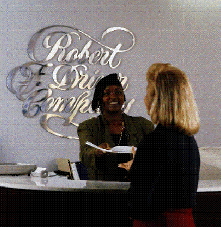
The receptionist, Ella McIntosh, greets agency customers.
When the mid-1970s rolled around, the Robert F. Driver Co. in San Diego, California, would have been characterized as an above-average, effective independent agency. Established in 1925 by Bob Driver, the agency had reached some $11 million in premium by its 50th anniversary in 1975. But then the "Class of '77," as it has been dubbed, came in and the agency really started taking off.
"We hired a lot of well-trained, talented people from insurance companies like Aetna, Travelers, Safeco and Hartford," Rick Gulley, vice chairman, points out. "These were people in their late 20s or early 30s who had been through company training programs. They were strong producers whose knowledge of the business gave us that value-added edge that set us apart from the competition."
Today, Robert F. Driver Co. has premium volume in excess of $300 million and total revenues of more than $28 million. The agency has about 215 employees and offices in Newport Beach, Sacramento and Escondido in addition to the nine-story headquarters building in San Diego.
One member of the "Class of '77" exemplifies the kind of talent that came into the agency in that year--Tom Corbett, Sr., who now is chairman and chief executive officer of Robert F. Driver Co. Tom's career with the agency started at Robert F. Driver Associates in Newport Beach, a new division that was established in 1977 to handle program business. Tom and two other producers were hired at Driver Associates. They started off with zero dollars in premium.
At that point in time, municipalities and other public entities were not something that any insurance company wanted to write. It was a downtrodden class that was viewed by most insurers as business that strictly went to the lowest bidder.
"So here we were being offered business that no insurance company wanted. Talk about luck. The ill-served classes provide the best opportunity for an effective program."
Tom continues that what made this even more attractive was the fact that "we knew that the myth about this business being controlled by the bid process was exactly that--a myth. In truth, public entities wanted and still want a stable market that will provide a long-term relationship at a reasonable cost. They aren't looking necessarily for the lowest bidder. They're looking for value."
He says that Driver Associates worked very hard to place the business, and the public entities really appreciated the effort. "Our efforts on their behalf bore a lot of fruit. Our name got around through word of mouth and that opened a lot of doors for us. We used that window of opportunity and built a large client base. There's no great secret to what we did. These people had a problem and we solved it. And today, we continue to work with them to provide the best risk transfer solutions for their needs."
The result is that Driver now is the largest independent agency writer of public entity business in the state of California. In 20 years, Driver Associates, which handles program business for public entities and hospitals, has gone from no premium to premium volume of approximately $80 million and more than $7 million in revenue.
Driver Associates brought to focus a philosophy that pervaded the Robert F. Driver Co. In essence, the program business involved "value-added" to the nth degree. And to do that, as Tom notes, "the program has to be controlled by the agency." He explains that there are two basic types of niche programs:
"There are the programs or products offered typically by the insurance company. To me," Tom continues, "that is not the type of program that provides stability or a real competitive advantage. It's subject to change by the insurance company and it's generally available to any agency.
"Then there are programs that are originated by the broker or agent," he adds. "We bring the volume together and bring it to the insurance company. When we control the program, it's transferrable," Tom points out. "To me, this is the only true niche market. The value-added doesn't disappear when the insurance company decides it wants out."
And Tom continues that this approach is being exported to all areas of the Driver company. "One of the keys to success is that we bring together enough premium volume to give us leverage when we deal with the insurance companies. The public entities in California have joined together into Joint Power Authorities (JPAs) in order to gain clout and we've been involved in helping them solve their insurance problems. Where appropriate, we've even brought some JPAs together."
The solutions can, and often do, include some level of self insurance. "We've helped the public entities put together programs that include a lower level of self insurance with an excess layer at the top level and a blended layer in between the retention and the excess layer where there is opportunity for dividends. We find that this helps maintain underwriting credibility since that dividend potential often serves to reinforce the need for careful risk management and this is reinforced by peer pressure. Nobody wants to be the risk manager of the public entity that blew the dividend for the group."
Tom notes that because the program business involves such a strong emphasis on loss reduction, it has been the most profitable business for the agency. "We are trying to bring this message home to all our clients and are working to create additional programs in which many of them can participate."
The agency is continuously involved in looking through its current book of business to find opportunities to create programs. As Rick Gulley explains, this is one of many ways to find a niche:
*"You can stumble across one.
*"You can have a company come to you wanting a particular type of business and you find that you already have 40 or 50 clients in that business.
*"You can put together clients that are in the same business and then go out and market that as a program to companies.
*"You can get run over by another agency that has put together a successful program and then scramble to catch up.
*"You can acquire one that already exists.
"And, to be honest," Rick says, "we've done all of these. But what we've learned from this is that leverage really counts."
Tom Corbett continues on that theme by pointing out that the agency's size has helped to contribute to its continuing success. "As we got bigger, the leverage that we gained from the premium volume helped to provide us with a significant competitive advantage--many would characterize it as an unfair advantage. That's exactly what we want to be able to offer to our clients--an unfair advantage. We want our program to be so good that other agencies can't come close to matching it. That's why we believe that the best way to create a niche is to build it ourselves. When we do that, we have the leverage to tell the carriers what that market wants and needs and, as long as it provides the insurance company with a reasonable chance to make money, we usually succeed in having our demands met."
Although 35% of the agency's volume still comes from its general commercial P/C business (Driver writes very little personal lines business, and the business it does write is done to accommodate its commercial lines customers), Tom says that more and more of this will be rolled into programs. "I want to see about 70% to 80% of our business generated through programs. I am convinced that this is the key to our success and the way in which we can best serve our customers."
Emphasis on the customer
Among the customer-driven emphases within the agency is the reorganization of each area into business service units so that any one of a number of producers and staff can help a customer. Rick Gulley notes that this has proven to be much more efficient, and there's no down time when someone is sick or out of the office for any reason.
Meanwhile, Driver's success continues to compound. As Rick explains: "We were able to grow, thanks to the talent and drive of the people we brought in in the mid '70s. And we wanted to continue to attract those kinds of people. One of the incentives that we added was an ESOP. The ESOP owns almost 50% of the agency, and this helps to get everyone involved in contributing to our success.
"We find that talented people are coming to us," Rick says.
Jerry Hall, the agency's chief operating officer, joined the firm about nine years ago and confirms Rick's statement. "I was working in the surety business at the Insurance Company of the West and wanted to try the agency side," Jerry says. "I wanted to become aligned with an agency that offered growth and was looking in the San Diego area. Robert Driver was the agency of choice. In fact, it was the only one I really considered. It's a very production driven organization that rewards all its employees for their contributions. The employee-owned nature of the company, given its success and presence in the insurance community, provides a significant attraction."
Jerry continues that there's a "real pride among all the employees in the successes that we've had, and we're extremely excited about what the future holds for us."
What's on the drawing board
That future should be extremely interesting and profitable for the people at Robert F. Driver. When one considers that the agency has enjoyed strong growth and increased profitability during a period of economic downturn in southern California, then it doesn't take much to envision even better results now that the economy is improving.
And Tom Corbett doesn't intend to have the agency sit still and rest on its laurels. "We've already expanded outside of California and are looking to create strategic alliances with like-minded agencies in other parts of the country. I don't think that we need to have a Robert F. Driver office in a state in order to bring our program to that state, but we do have to have a presence and there's no reason why that can't be another quality agency. This still is a people business, and I don't believe that a program can be sold just over the phone. We may be in the electronic age, but the personal touch remains extremely important. You've got to be present at the group's trade meetings and there personally when a problem occurs. And that's where these strategic alliances come in. It really is time for agencies to stop seeing each other as competitors and start looking to each other for opportunities.
"And I would like to see the barriers fall down at the carrier level as well. We work with reinsurance companies, alternative markets and traditional insurance companies in order to provide our customers with the best programs. These aren't really competitive products as much as they are different ways to manage risk."
Thanks to the leverage enjoyed by Robert F. Driver, some of these walls may indeed come down, at least for the agency's clients. And, based on the tremendous success the agency has enjoyed so far, this very well may be the Joshua needed to sound the trumpets. And we'll add our own fanfare in their direction in the form of a well-deserved Agency of the Month recognition.
The author
Dennis Pillsbury has more than 20 years' experience in insurance journalism, both as an editor and freelance writer.