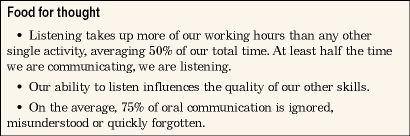
Listening differs from hearing. Listening is a learned skill. It is active. Hearing is passive. People remember only about 25% of what they hear, as opposed to 85% when they actively listen.
In order to be effective in retaining customers, we need to actively listen to their needs, expectations and complaints. Since so much of communication is not immediately clear, we need to actively listen and ask gentle, probing questions to ensure clear understanding. Successful agencies have people who are excellent listeners. These agencies have people who genuinely care, which is a key ingredient to being a good listener.
Signs that a person genuinely cares about the customers are evident in the hiring process. For instance, when the job candidate was completing the employment application, did (s)he answer all the questions neatly and clearly? When you asked a question, did (s)he answer it directly or ask for clarification? When you spoke with the job candidate on the telephone, did you sense you had this person's undivided attention? During the entire hiring process, did this person ask you and others questions, to want to know more?
Given that listening is not innate, where do people learn to listen? Schools have not recognized the need for students to become good listeners to be successful in the world. In fact, I know of only two colleges that offer courses on listening.
Think about it. We listen more than any other activity, except breathing and we have no training for it. Listening is the "receiving" part of communication. It is:
1. Receiving information through your ears (and eyes)
2. Giving meaning to that information
3. Deciding what you think (or feel) about that information
4. Responding to what you hear
Given the importance of listening and the lack of training in developing that skill, here are some of the key points on listening from the communication workshop that we developed. (See sidebar on page 64.)
Listening pays off handsomely for everyone. It is a big win-win. It will:
1. Increase you income. If you listen carefully to your customers, you will detect the best opportunities to ask for referrals which will increase your income.
2. Lessen stress on the job. Defusing an angry customer by resolving the issue in a manner which is positive for that customer will markedly reduce your stress.
3. Improve your agency's profits, ensuring continued employment. If you listen carefully to your customers and ask probing questions, you will uncover additional cross-selling opportunities for your products and services.
4. Make you more promotable. When you take time to ask questions to ensure that you understand the customer's request, you will avoid redoing work which in turn increases your efficiency and readies you for the next step in your agency.
5. Increase your job satisfaction. When you can easily resolve problems for both internal and external customers, you will enjoy your job more.
6. Improve your ability to problem solve. By actively listening, you will have more information which increases the number of options you have to resolve a customer's particular problem.
7. Keep you aware of what is going on in your organization. Since your listening skills will be sharper, you will be more knowledgeable about what is going on in your organization. You will experience fewer surprises.
--Anonymou
So now you may be thinking, how can I become a trained listener? Here are some key tips to set you on the path of learning this most valuable skill.
Take notes. Each time you interact with a client, either on the phone or in person, chances are you're making notes. (Document, document, document!) Doing this actually helps increase your memory retention. You can expand that activity by having a small note pad and a pen with you at all times. Jot down the salient points and don't be overly concerned with neatness. Focus on the key phrases, active verbs and feelings.
Listen now, then feedback what you heard to the customer. Repeat, using your own words, what you understood the customer to say. For instance, "Let me make sure I heard what you said. You..." or "O.K., thanks for telling me. Let me see if I have everything. You..."
Become an active listener. Active listening is a learned skill and like any skill it takes practice. To become an active listener you must focus on the customer and carefully listen for the content of the message. Don't become distracted by how a customer expresses him/herself. Focus on what is being said. Active listening requires desire, discipline, interest and concentration so ask questions, show interest, express concern and pay attention.
Be present. In other words, don't fake attention. Guard against the tendency to daydream or allow your mind to wander. Some people daydream up to 50% of the time when they're not engaged in conversation.
Anticipate excellence. You will receive good information more often when you expect to receive it. However, you can facilitate the information gathering by asking clear, open-ended questions. "Brainpower" is the power of our expectations.
Be a "whole body" listener. Whether you are in a face-to-face meeting, on the phone or even reading written correspondence, listen with your ears, eyes and your heart. If you are on the phone with a customer, convey a positive, encouraging attitude by sitting in a comfortable position, as if the customer were seated before you. Smile into the telephone. Tune into the customer's feelings and ignore or eliminate distractions.
Build rapport by "pacing" the speaker. Match the customer's pace, rate and volume of speech, vocabulary and breathing. Approximate the customer's words, phrases, expressions and voice patterns.
Control your emotional "hot buttons." There are certain types of people or situations that can "push your buttons." The skilled listener gets to the real message and ignores the superficial "distractions." By distractions, I mean expressions of anger or frustration such as: "You never..." or "You always...," an individual with a "know-it-all" attitude, people who use bad grammar, pushy people, whiny people, or dictatorial people.
Control distractions. Distractions provide novelty, variety and intensity, and they can take your focus away from the customer. For example, if you have customers who are particularly soft spoken, difficult or talkative, take the call in a private setting--close your door, so you can more easily concentrate on what the customer is saying.
Listening is a gift, give generously. While you become gifted when you become an active listener, you must give more to your customers, specifically your time and attention. Listening is an acknowledgment of caring and is a potent retention tool. Customers want to be cared about and acknowledged. It is a powerful human need.
As you become a better listener, you will most likely find your job becoming more enriching and you will become more successful. Why? Because you will be interacting more with everyone; you will be more involved and engaged. You will have more information and be better able to see new and innovative opportunities and solutions in this rapidly changing marketplace. After all, isn't that what your customers expect you to deliver to them? *
The author
Lynn Thomas, J.D., is president of 21st Century Management Consulting located in Waltham, Massachusetts, a firm specializing in customer loyalty and customer retention with a specialty in the insurance industry. In addition to her consulting work, Thomas has written for numerous publications and has been a speaker at hundreds of conventions. A packet of information on the art of listening is available at cost from 21st Century Management Consulting. Please call (781) 899-4210 for more information.
There are some classic differences between people who are trained listeners and those who are not. As you read through the following, think about which category you identify with most strongly.
1. Untrained listeners: You tune out some of what the customer is saying because you know what the answer is.
Trained listeners: You defer judgment. You are more controlled. You listen for the customer's feelings and assess the situation.
2. Untrained listeners: You are quick to mentally criticize grammar, voice tone, speaking style, etc. Your attention is directed toward style.
Trained listeners: You pay most attention to content--not to appearances, form, or other surface issues.
3. Untrained listeners: You spend time rehearsing your response rather than fully listening to the customer. This becomes evident to the customer.
Trained listeners: You listen completely first, trying to get every nuance. You really strive to understand the person. This enthralls people.
4. Untrained listeners: You tend to listen mainly for facts, specific bits of information.
Trained listeners: You listen for the main idea.
5. Untrained listeners: You attempt to take in everything the customer is saying as well as reply to everything, including exaggerations and errors. (Referred to as fogging.)
Trained listeners: You concentrate on the customer's main issues only. There's no need to reply to everything. Avoid sidetracking remarks.
6. Untrained listeners: You pretend to be paying attention.
Trained listeners: You are aware of the human tendency to fake attention and know your own internal cues. You genuinely care about what the customer is saying and therefore your mind wanders less.
7. Untrained listeners: You divide your attention among two or more tasks.
Trained listeners: You do one thing at a time. You realize that listening is a full-time job.
8. Untrained listeners: You give up too soon when you realize you have to work to actively listen to what the customer is saying.
Trained listeners: You listen carefully. You sort, give feedback and ask for confirmation.
9. Untrained listeners: You tend to become distracted by emotional words. You have difficulty controlling your own emotional responses.
Trained listeners: You control your anger when you feel it. Emotions do not govern behavior.
10. Untrained listeners: You give few, if any, verbal responses.
Trained listeners: You give affirming and affirmative statements. You invite additional comments.
11. Untrained listeners: You are impatient to "get on with it."
Trained listeners: You have learned to be patient.
12. Untrained listeners: You interrupt the customer.
Trained listeners: You are silent for a few seconds after a customer finishes to be sure (s)he has completed that thought.
13. Untrained listeners: You are not aware of the talking/listening "speed limits" mismatch. If someone is speaking at a different speed than you are, you are more likely not to stay connected with that person's line of thinking, lose his or her main point and focus on what is more of a tangent than the main point.
Trained listeners: You maintain the same speed of talking as the customer to maximize rapport.
Editor's note: This quiz is based on information taken from Thomas' one-day workshop "Communication: The Essential Ingredient to Success." The workshop covers other important aspects of communication: how to handle the upset, talkative and argumentative caller; powerful words and phrases to be an effective communicator; giving and receiving feedback, etc. Thomas offers this to agencies and for conventions on a customized basis only.
©COPYRIGHT: The Rough Notes Magazine, 1998