SPECIALTY LINES
YACHT MARKET MOSTLY STABLE, BUT FLORIDA HAS A FEW PROBLEMS
Agents representing CIGNA Recreational Marine size up the problems and the opportunities
By Phil Zinkewicz
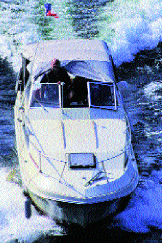 For owners of yachts and other pleasure craft, the news is good. The market is a competitive one where, in most parts of the country, coverages abound and prices are stable. But top insurance agents agree that in Florida and other locales where Hurricane Andrew and other natural catastrophes left their mark, coverages will likely remain scarce. For Florida, especially, there are other problems.
"It's not just the hurricanes," said Jaclyn Turner, vice president of operations for the St. Petersburg, Florida-based Wisely Marine Insurance Agency, "but other factors as well that cause problems for the Florida market. There are difficulties involving fraud and theft as well. There are instances of yachts and other types of pleasure craft being stolen and then transported to Latin America. And the fraud problem involves false claims. Some companies did pull out of the pleasure craft market, but not as many as those which pulled out of the homeowners market. Marine insurers have been more loyal, especially CIGNA which has remained in the market throughout all the difficulties," she said.
These observations were thematic throughout the CIGNA Recreational Marine's sixth annual Captain's round table, a gathering of some of the nation's most experienced recreational marine insurance agents and brokers, held last spring. The delegates, whose clients span all the nation's key insurance markets, are selected each year by CIGNA on the basis of overall yacht insurance sales and contributions to the recreational marine insurance marketplace.
"The market for recreational marine insurance has remained highly competitive in recent years, which has led to price moderation in most key markets," according to the consensus of those who participated in CIGNA's Captain's round table. According to the proceedings of the meeting, the delegates agreed they continue to face difficulty in obtaining coverages for yachts in the Florida market as the industry continues to reel from the effects of Hurricane Andrew and other, more recent, catastrophes.
"Not surprisingly, given the heavy concentration of recreational marine business in Florida, all of the delegates pointed to problems of obtaining coverages there as the most significant concern facing their clients today," say the round table proceedings.
Agents at the meeting said that they saw no immediate solutions on the horizon for the scarcity of coverage in Florida, and stated they believe only time will tell how long it will take for insurers' fears to ease sufficiently for them to reenter the market. In the meantime, expectations are the trend toward higher catastrophe and wind deductibles and policy sublimits will continue. While agents at the round table meeting indicated understanding of the rationale behind insurer-imposed restrictions designed to keep yachts out of Florida during hurricane season, some believe that enforcing the ban through the end of October (the end of hurricane season) may be too restrictive. According to the round table proceedings, one agent said: "...not being allowed back into Florida until November 1st does tend to create a problem for some policyholders."
 But the problems for yacht owners in Florida seem to occur on a selective basis. For new yachts and other pleasure craft, the market is apparently opening up a bit, according to Kurt Limbo of Sea to Sea Underwriters. "Some standard insurers are beginning to move into the recreational marine market. So for the newer boats, there is not much of a problem. Owners of the older vessels are experiencing the scarcity of coverage."
For those who are experiencing the dearth of coverage in the Florida market, the agents who attended the round table suggested that more and more yacht owners might consider self-insurance as a viable option. "This is particularly true of older vessels, which are less likely to be mortgaged, and high-performance craft for which coverage may be unavailable at any price," says one of the round table agents interviewed.
Says the round table executive summary: "Clearly, recreational marine agents are looking to insurers to devise workable solutions that will bring capacity back to Florida." Some agents at the round table offered the possibility that some sort of reinsurance facility might be established to encourage primary companies to move back into the market.
The agents at the round table also agreed that the litigious nature of American society remains a consistent theme when it comes to the top fears of today's yacht owners. It appears that frivolous lawsuits against yacht owners continue to mount. "Liability limits of $1 million or more on recreational marine insurance policies are commonplace, and are being supplemented in many instances by umbrella liability policies that provide broad protection against liability regardless of source. Also a topic of increasing concern is yacht owners' potential exposures to workers compensation claims stemming from injuries to crew. Owners of larger yachts, which are more likely to employ a professional captain and hands are naturally seen as facing the greatest risk."
The agents at the round table also pointed to confusion of yacht owners regarding their pollution exposures as a source of concern. While current insurance policies typically cover cleanup costs in connection with accidental discharges, the fines and penalties vessel owners may face in cases of negligence--which are excluded from coverage--can run into the hundreds of thousands of dollars. While some agents at the meeting said they believe the level of exposure yacht owners face is reduced somewhat by the limited fuel and oil capacity of smaller boats, others expressed more concern.
But the problems that yacht owners in Florida face that is greater than any other, according to Limbo, is the fraud and theft problem, particularly fraud. "Florida is a rapidly-growing state in terms of population," said Limbo. Its nearness to the Caribbean makes it ripe for undesirables to steal a boat and then use it to transport drugs, sometimes even sink the vessel. As for fraud, there has definitely been an increase in fraudulent claims regarding injury and vessel damage. This is something that the industry must consider doing something about. *
©COPYRIGHT: The Rough Notes Magazine, 1998