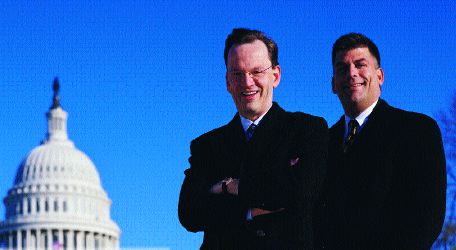
Council of Insurance Agents & Brokers executives Joel Wood (left), senior vice president, government affairs, and Ken A. Crerar, president
One of the key provisions of the Financial Services Reform legislation recently signed by President Clinton was the creation of a "big stick" designed to force states to develop ease of licensing for agents wishing to operate in more than one state. The legislation sets a timetable for states to adopt reciprocal laws on agent licensing or the feds will step in and set up their own system.
The law would set up a National Association of Registered Agents and Brokers (NARAB) as a governing body over agencies that wish to become federally licensed. Agents and brokers could opt to continue to be licensed on a state-by-state basis, meeting the applicable standards of each state or could meet the standards of NARAB and, after paying the licensing fees for the appropriate states, would be able to operate in those states.
The law, however, gives states a chance to avoid the creation of NARAB. Under the legislation, if 26 states adopt full reciprocal licensing requirements within three years, NARAB will not be formed. After three years, the National Association of Insurance Commissioners would then have to create NARAB within two years or 26 states representing the majority of commercial insurance premium would have to adopt reciprocal licensing requirements. If neither of those requirements is met, the federal government would create NARAB as a stand-alone, self-regulating body. So, in essence, we now know that five years from now--or sooner if the states get their act together--we will have some form of national agent licensing.
We talked to Ken Crerar, president of the Council of Insurance Agents and Brokers (CIAB), and Joel Wood, senior vice president of government affairs for the Council, about the association's efforts to get this provision into the reform legislation. "This has been 11 years in the making," Wood says. "But our real push came about three years ago when we decided to focus all of our efforts on meaningful modernization for agents. We had lost many of the big battles on the issue of banks and insurance and decided this was the best route to take for the benefit of our members."
 Ken Crerar says CIAB formed its first committee to deal with interstate licensing in 1939.
The problem of multistate licensing has been a concern of CIAB for many years. "We formed our first committee to deal with interstate licensing in 1939," Crerar points out.
CIAB (formerly the National Association of Casualty and Surety Agents) was founded in 1913 to represent larger metropolitan agencies, Crerar adds. The name was changed in 1993. In July 1998, CIAB and the National Association of Insurance Brokers merged. "The association's roots have always been in larger commercial agents and brokers. We have fewer than 300 members, but they write around 80% of commercial premiums. Most of them act as both brokers and agents."
CIAB has a staff of 25 people. Crerar joined the association in 1987 and was named president in 1991. At that time, the association had a staff of six.
 Joel Wood says licensing issues are complex for the typical CIAB member firm which often writes at least one national program and has to hold more than 100 licenses.
Wood explains that the NARAB concept originally appeared in solvency legislation proposed by Congressman John Dingell (D-MI). That legislation, among other things, would have created a federally constituted body to oversee agents and companies that chose to become federally chartered.
"Our typical member," Wood points out, "usually has one or more national programs and often has to hold more than 100 licenses. The differing state licensing laws really have been barriers to competition. There's almost no way for agents that operate in all states to be fully compliant with each of the states' laws. What's happening in the marketplace really is massive non-compliance," he claims, adding that agents try to comply but often cannot and just get as close to compliance as possible.
The NAIC began work on a model law on agent licensing in 1997. At press time the model had not been adopted but adoption was imminent. "The problem with NAIC models is that they are only advisory. States can add or subtract and when that happens, there's no true reciprocity."
Wood continues that the legislation would preempt only residency barriers and other restrictions that impede the ability to operate on a multistate basis. "There is nothing in the legislation that usurps state unfair trade practices. Fraud oversight and market practices would remain under the purview of state regulators."
He also points out that the legislation calls for the president to appoint state insurance commissioners to run NARAB if its creation is triggered by state inaction. However, when President Clinton signed the legislation, he indicated that he felt this provision was unconstitutional and would be considered only advisory in nature.
"The nature of this business is interstate," Wood adds. "The often anachronistic state laws on licensing inhibit competition. This legislation creates the political dynamic for state action."
Under the legislation, NARAB would set standards of professionalism that would have to exceed any standards of professionalism currently required by the states. "Completion of CPCU, for example, could be one of the standards," Wood suggests. He points out that NARAB "in many respects, is modeled after the NASD. We hope that an emphasis on professionalism will serve to enhance the reputation of insurance agents in general. Currently, the state standards really are designed to raise revenue for the states rather than focusing on professionalism. Our primary motivation," he admits, "was to make life easier for our members; but if this has the added benefit of improving the image of insurance agents and brokers, we'd be extremely pleased with that result."
Future plans
Following his election as the new chairman of CIAB, Robert A. Gleason, Jr., said the year 2000 "will see the Council focus on initiatives of vital importance to our members--the country's top insurance intermediaries, risk consultants and financial advisors." Gleason, who is chairman and CEO of The Gleason Agency, Johnstown, Pennsylvania, was elected chairman of CIAB at its annual meeting October 2-6 at the Greenbrier in White Sulphur Springs, West Virginia. Gleason has been a member of CIAB since 1982 and has served as a director, secretary, treasurer, vice chairman, and chairman of the education and legislative affairs committees, A graduate of the University of Pennsylvania, where he presently serves as a trustee, Gleason has served in a wide range of community leadership positions in his hometown of Johnstown. He also has served as Pennsylvania's Secretary of State and as a member of its turnpike commission.
Of particular interest, Gleason continued, is the first annual Commercial Insurance Legislative Summit, which is to be held February 6-9, 2000, in Washington, D.C. The summit is a joint initiative of the CIAB, the American Insurance Association, and the Reinsurance Association of America. "The three associations that lead the commercial insurance marketplace have joined together so that we as an industry will speak with a more powerful voice on Capitol Hill," Gleason said.
Another initiative is the Producer Recruitment and Industry Perpetuation Program which was launched by CIAB as an effort aimed at bringing new talent into the industry. Several insurance carriers have contributed to the program.
In the area of electronic commerce, CIAB members and the association are involved in various e-commerce initiatives to strengthen the role of insurance agents and brokers on the Internet.
"The bigger agents and brokers have never been more united than they are right now within the CIAB," Gleason added. "We are 100% united in all issues facing the industry. We are working together to tackle problems on a global basis." Gleason also said he expects the number of members in foreign countries to grow in the coming year. The Council presently has members in nine foreign countries.
In addition to Gleason, other officers elected at the meeting were:
Vice Chairman--Thomas J. Rodell, executive vice president & COO, Aon Risk Services, Inc., of Illinois, Chicago.
Treasurer--John L. Van Osdall, senior vice president, USI Insurance Services Corp., Houston.
Assistant Treasurer--William R. Wilkerson, III, chairman & CEO, Haas & Wilkerson, Inc., Shawnee Mission, Kansas.
Secretary--Frederick J. deGrosz, president & CEO, ABD Insurance & Financial Services, Inc., Belmont, California. *
©COPYRIGHT: The Rough Notes Magazine, 2000