Like a dog chasing its tail, the pursuit of clients and prospects can sometimes go round and round with little more than dizzying results. Yet unlike that dog, whose frantic spinning continues until exhaustion, agents and brokers actually have a chance to profit from their pursuit.
In many cases, a successful outcome can be traced back to the beginning of the chase--that moment of inspiration when both parties involved decide that the relationship is worth exploring further. Public speaking engagements--especially those that put agents and brokers in front of an audience of decision-makers and prospects--present an excellent opportunity to spark that inspiration. They can enhance your image, boost visibility and credibility and show your target audience that you are a valuable resource in the community.
Town meetings, civic and business associations and large corporations in your marketing area can present ready-made opportunities and put you in front of an insurance-buying audience. And if you find that speaking opportunities are scarce, you can create them. In fact, more and more insurance agents and brokers are teaming with other local professional services firms (attorneys, investment brokerages, etc.) to host seminars that are open to key prospects and to the public.
Regardless of where you're speaking, it's important to take full advantage of the opportunity and to make a favorable impression on the audience. There are a few areas on which you can focus to make the most of your speaking engagements.
Customize your content
Any speech, no matter the length or subject, should be developed with the particular audience in mind and tailored to its needs and interests. Customization can mean the difference between a presentation that leaves the audience informed, enthused and interested in learning more about you and your agency and one that is forgotten soon after the lights are turned on.
The first step in customizing your speech is to analyze your audience as thoroughly as possible. Be sure you know the approximate number of attendees, their degree of familiarity and experience with your topic, and the primary reason they are attending.
Also keep in mind that every audience has a secret hope that they will be inspired by the presentation. Most people are looking for just one tidbit of information that can help them in their jobs or personal lives, and they'll be delighted if you deliver it.
So when you're determining the specific content of your presentation, adopt the attitude that you can genuinely help the audience. Think about the main benefit they will derive from your presentation and the major concerns they have that you can weave into your content. Keep those thoughts at the forefront of your thinking as you develop your speech.
Throughout your presentation, keep the audience aware of the primary message you are communicating. Summarize and reiterate the main points in each section before moving on to a new topic, and make your transitions to new sections obvious and clear cut. Also, be sure to conclude with a strong summary statement that connects back to the key benefit to the audience.
A final factor of which you should be aware when determining content is whether or not you want to use your presentation as a platform to promote your organization.
While a speech to an audience that is full of prospects can be a tremendous marketing opportunity, proceed with caution. If you're invited to speak as the representative of the industry, the audience will be expecting an independent viewpoint or a straightforward presentation of an issue. If that's the case, they're sure to be turned off by a heavy-handed marketing pitch. It's better to let your experience and expertise do the selling.
Make good use of visual aids
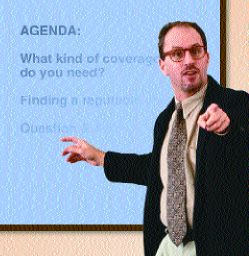
Slides, overheads and presentation software can make your presentation leap out at the audience. They can add emphasis to important points, drive home specific topics and make your speech more memorable. There are a few simple guidelines you can follow to make the most of the visual aids you use.
For starters, make your slides or overheads easy to read and understand. Think of them as billboards, not memos. Don't cram each slide with text and then read it back to the audience. Instead, use them to highlight key words, thoughts or phrases, then fill in the details verbally.
It's also important to time your slides and overheads precisely with the words you're speaking. Never expect the audience to listen to one subject or detail while reading something different on the screen. It's just too much work and confusion. Nine times out of ten, your message will get lost in the mix.
Along those same lines, avoid the temptation to pack your presentation with visual aids. Instead, limit your use of visuals to only the most relevant material. Use them to root the audience in the specific subject at hand, emphasize key points or to present detail-intensive information in simple charts or graphs.
Finally, if you're using a software-based presentation tool such as Microsoft PowerPoint, make sure the room in which you'll be speaking has the appropriate capabilities. Having the presentation on your laptop is no guarantee that the facility will have the equipment you need to project it to the audience.
Hone your physical presentation skills
In addition to content that's relevant to the audience, physical skills are the foundation of any effective presentation. To many audiences, confidence, enthusiasm and sincerity are critical cues to your professional competence. Often, these traits are best projected by the way you handle yourself physically. Here are a few keys to putting your best foot forward physically.
It may sound simple, but you'd be surprised at how many people fail to maintain good posture while speaking. Standing tall, as opposed to hunching over or leaning on the podium, is an essential starting point for projecting the confidence you need to impress the audience.
Eye contact is also key. You want to speak to individuals in the audience and establish eye contact with people throughout the room. Lock in on a particular person, and hold eye contact until you have completed a thought and feel comfortable and in control. What's more, when you pause to think, avoid the temptation to let your eyes roam the room. Instead, try to remain focused on an individual.
Contrary to what some people may think, there's nothing wrong with using gestures during your presentation. In fact, they can add emphasis to your presentation. With gestures, there are a couple of key ideas to keep in mind. First, one-handed gestures are generally more effective and less distracting than two-handed ones. Second, don't plan them. If gestures come naturally to you, use them. Once you start thinking about gestures and practicing them, they usually start to look unnatural to the audience.
Put your verbal skills to work
Verbal skills work hand in hand with content and physical presentation skills in determining the effectiveness of your speech.
Unless you feel completely naked without a script, don't read from one. Use index cards or an outline instead. Invariably, speeches read from a script sound dry and stilted, which makes it especially easy for the audience to lose its attention.
You also want to communicate with a high energy level. Be alive and aggressive. Vary the length of the sentences you use, and modulate your voice and speech patterns so you don't give your entire presentation in a monotone. Another useful tip is to convince yourself that you're the best at what you do, since that self-confidence will most certainly show through to the audience.
Be prepared for questions
Whether there's time allotted for them on the schedule or not, it's always best to be prepared in advance for any questions you may receive during or immediately following your presentation. After all, questions give you an additional opportunity to connect with individual audience members and demonstrate your expertise to everyone present.
A good way to prepare is to list all the questions you think you may be asked and develop complete written answers for them. Prior to your presentation, review the questions with an associate and practice your responses.
When fielding questions from the actual audience, always rephrase each question before answering. It will help ensure that everyone in the room understands the question and can give you a few extra seconds to formulate an answer in your mind.
If you aren't sure of the answer to a question an audience member may ask, don't try to "wing" it. Jot down the name and number of the person who asked the question, do the research as soon as you get back to the office and call the person promptly with an answer. In addition to showing your willingness to go the extra mile, you'll also lay the groundwork for a one-on-one relationship with the prospect.
Speeches and presentations can be an excellent source of new business, both immediately and down the road. By following these tips, you can take advantage of that opportunity. And since you can apply many of the techniques in this article to smaller meetings (particularly new business presentations), that's all the more reason to work on your presentation skills.
The author
Kimberly Paterson has been providing marketing and communications services for independent agents and insurance companies for more than 20 years. In that time she has worked with agents and brokers in all facets of marketing, from developing communications programs and research initiatives to designing advertising campaigns and promotional materials. Her Red Bank, New Jersey, marketing communications firm, Creative Insurance Marketing Company, combines marketing and research/analysis with creative advertising services exclusively for the insurance industry. She can be reached at cimco@compuserve.com.
©COPYRIGHT: The Rough Notes Magazine, 2000