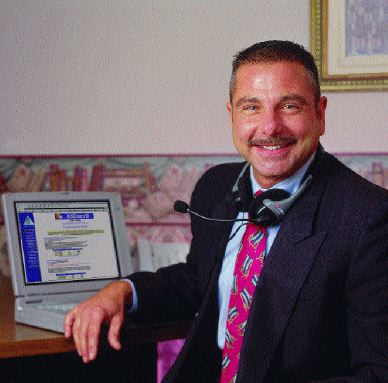
Applied System Client Network (ASCnet) Director of Education David Andrukiewicz says a computer, a computer headset/microphone and a CD containing the collaboration software pave the way to Internet-based continued education.
Parents learn early on about the so-called reachable, teachable moments with their children. Those precious "now that I have your attention" instances where meaningful communication occurs. Though not a close parallel, being director of education for a large user group organization can be equally challenging. The organization needs to be able to reach its members in order to teach its members.
David Andrukiewicz, director of education for the Applied Systems Client Network (ASCnet), the 5,000-plus member organization for users of Applied Systems' technology, knew the organization wasn't reaching all the potential members and to some extent, not serving its existing members with its traditional approach to member education. Surveys of members and nonmembers indicated that the principal reasons for nonparticipation in traditional education offerings--local chapter meetings, education summits and the annual education conference--were cost and time--two reasons that were closely related. According to survey respondents, the cost of attending a session wasn't limited to the registration fee. There were also expenses related to travel, food and lodging. Another big consideration was the participant's time away from the office when attending a session. Time, after all, is money.
Andrukiewicz's charge: break with tradition--find an innovative way of delivering education that would address the time and money concerns expressed by the survey respondents.
The solution was as obvious as the Web browser on his desktop. So Andrukiewicz began a research project that would familiarize him with the concept of Web-based distance learning. The result of his research: ASCnetU. Rolled out in July 2000, ASCnetU is a training delivery mechanism that provides continued education on Applied Systems' agency management system. ASCnetU conquers a person's inability to be two places at once. Participants and session leaders alike can stay in their respective offices (and close to home) yet still be "together" thanks to Centra Software's Web-based collaboration software that ASCnet selected to power its distance learning initiative. The ASCnetU sessions are "live," affording real-time interaction. Classes last 60 to 90 minutes and cost $35--that's $35 per class, not per participant. So if an agency wants a number of people to attend an ASCnetU session, it's a flat $35 fee.

He continues that the participants need a headset because of the interactivity of the sessions. Although many participants have multimedia computers with speakers, office etiquette prescribes some means for keeping down the volume, out of respect for one's neighbors on the other side of the cubicle wall. The headsets do just that. And even in a conference room setting where the speakers could be used to benefit a larger group, the microphone is controlled by the session leader and the participant working the keyboard, meaning only one person at a time can speak and be heard. The $64 one-time fee for the fulfillment kit is added to the $35 session registration fee, so the initial class costs $99. Registration and payment are handled at the ASCnet Web site.
But beyond needing a headset and microphone, that's about as demanding as the technology gets. According to Watertown, New York, agency owner Pat McEvoy, the hardware specifications to participate in ASCnetU (detailed at the ASCnet Web site) are in line with what he needs to run the current version of WinTAM.
 Andrukiewicz points out that ASCnetU is a cost effective, time efficient way for agencies to learn how to better use their Applied System technology.
ASCnet Communications Director Tom Morgan facilitates a 60-minute orientation class before new participants "attend" their first ASCnetU class. The first half of the class is carried out via a conference call. Once the preliminaries are completed, the conference call is released and the remainder of the orientation is carried out via the Internet. Pat McEvoy had never participated in an online class before and appreciated this "walk through" which included installing and getting comfortable with the software and the headset/mic. He says the orientation gets everyone "on the same page" so when they do attend their first ASCnetU class, minimal time needs to be devoted to getting comfortable with the hardware and/or software.
But that's not to say that at the start of each session there's not at least some time given over to "sandbox" time, where participants can reacquaint themselves with some of the important features of the Centra collaborative software. Andrukiewicz encourages the ASCnetU leaders to offer an "ice breaker" activity where the leader gives each of the participants a turn with the mike so they can tell the rest of the participants their name, their agency responsibilities and where their agency is located. Then they use Centra's "white board" tool to plot the agency's location on a map.
In a virtual classroom setting such as ASCnetU, there are some important considerations. A participant can't simply raise his/her hand to alert the instructor that he/she has a question or comment. The participant needs to activate a hand icon to accomplish the same end. The leader is then alerted and can activate the microphone for the participant with the question. Jennifer Godwin of Timberline Insurance Services in Austin, Texas, has taught several ASCnetU sessions geared toward CSRs. And although the participants have been through the orientation and know how to talk and raise their hand using the Centra software, she still likes to provide a quick refresher course. She says she asks the participants in her groups to raise their hands if they're feeling good today. She reports that all the participants in her classes interact. "I haven't been through a class where everyone hasn't talked."
Of course, there are challenges that the leaders must address as well. Godwin explains that the lack of face to face interaction took some getting used to. "When you're in front of a group, even a large group, you can see their faces, and you know whether or not you're connecting. With ASCnetU, I ask for reactions. Based on the responses I get, I know whether I'm going too fast, if I'm being clear, if they're comprehending."
Although her sessions focus on CSRs, Godwin says she's had agency principals participate to see if the session would be beneficial for employees. The results speak for themselves. "One principal has attended every class we've offered," she notes. "The people who have participated in one ASCnetU course say they'll attend more."
Pat McEvoy is one of the repeat participants. He's attended every session offered to date. McEvoy, Ltd., migrated to WinTAM about 18 months ago from another system. So as part of the agency business plan this year, McEvoy committed to using WinTAM more effectively. "As the agency principal, I want to be as well versed on the system as anyone else in the agency," he remarks. ASCnetU is a convenient and cost effective way for him to achieve that end. The sessions he's attended have included six or seven people, which, from his perspective, is an ideal size to facilitate good interaction between participants and the instructor. "In a larger setting, we wouldn't have the close interaction. ASCnetU enhances the ability to learn."
And as for the convenience, McEvoy couldn't be happier. "I much prefer sitting in my office taking an online class to traveling to a session."
The compact class size that McEvoy appreciates is no accident. David Andrukiewicz explains that classes are intentionally kept to 10 or fewer participants to facilitate interaction.
Andrukiewicz acknowledges that building course content for ASCnetU requires some new skills not needed when developing a course for a traditional education offering. So he went back to school himself to get up to speed, starting with the free classes offered by Centra. He notes that ASCnet has an advantage over some of the other Centra users he encountered during his research. "ASCnet has existing content-presentations made at the annual education conference and at the summits. All we have to do is adapt it to this technology."
The sessions include PowerPoint presentations as well as application sharing. It's the application-sharing element that Andrukiewicz describes as a major advantage of the Centra software. "Being able to grab a WinTAM session and show it to the participants while it's being discussed is critical. There's no sense in training someone on something they can't see," he asserts. Conference sessions that are adapted for ASCnetU are shortened to fit into the 60 to 90 minute time frame allocated for ASCnetU sessions.
Andrukiewicz says ASCnet is being conservative in the roll out of the ASCnetU curriculum. "We've all experienced things that have been rolled out before they should have been," he notes. By year-end, the following six course offerings should be available:
* Efficient Use of WinTAM
* Month-end Processing
* Introduction to Win Reports
* Transactional Filing
* Advanced Win Reports
* WinTAM Workflow
He encourages ASCnet members to visit the Web site regularly for curriculum updates. As for "coming attractions," he says the education committee is developing an ASCnetU course on disaster planning, as well as a "full-blown, soup-to-nuts" accounting class that will consist of several parts.
As with other aspects of the ASCnetU development and roll out process, the availability of recorded sessions is being approached with the members' needs in mind. Andrukiewicz explains: "We're starting out providing the live, interactive sessions. Once these are tweaked to the point where they're smooth and well done, we'll record them and make them available at a lesser cost than the live sessions. They'll be available for members' use anytime. Suppose you attend a live class and have to leave for some reason, you could purchase the recorded session and still get the information. The recorded sessions, along with the 'handouts' that are distributed to participants via a link at the end of each ASCnetU session, will also serve as good review materials."
Just prior to the July launch of ASCnetU, one of the more ambitious pilot tests of the system took place. Marshfield, Massachusetts, agent Peter Anderson, who is vice president of the ASCnet board of directors, was in England, attending the United Kingdom's TEAMONe education conference. Christine Forbes of The Daniel and Henry Co. in St. Louis, was the session leader. In addition to the England-based attendees, and the St. Louis-based leader, there were also participants in Canada and along the east coast of the United States. Anderson recalls there was a span of seven hours from place to place while the session was going on. "We had real-time video, audio and application sharing where we were demoing WinTAM workflows--with no delays," he emphasizes. Participants could "raise their hand" using the Centra technology, without regard for their proximity (or lack of it) to leader Christine Forbes in St. Louis.
Forbes notes that ASCnetU makes people more comfortable with asking questions. "In an office setting, an individual might be embarrassed to ask a question because then colleagues would know they didn't know. With ASCnetU, people don't see each other. People are less inhibited." In addition to enabling participants to "raise their hand," the Centra software includes both a public and a private chat feature. The private chat feature enables participants to correspond "offline" with the session leader for a more private exchange.
In her sessions on accounting related functions, one of Forbes' "ice breaker" questions also serves as a reality check. "How many of you have tested your backups?" she asks. While her question encourages participant interaction and use of the technology, she says it also gets the participants to do a bit of disaster planning.
Maureen Boeing of Landmark Insurance Agency in Cincinnati will be leading ASCnetU sessions once she becomes a certified ASCnet presenter. She's already presented a demo of an ASCnetU session for the Southwest Ohio ASCnet Chapter. The members were enthusiastic about the concept, she says. "They liked everything about it ... it's inexpensive, it doesn't take people away from their desks or out of the office for extended periods and it's one more good reason for every agency to have Internet access. Everyone in the agency doesn't have to have access, but someone in the agency needs to have access."
"If members can't get to the meetings, ASCnetU is a great way to bring the meetings to them," Andrukiewicz observes.
"ASCnet is a technology organization," Peter Anderson continues. "Our whole effort is to promote education to our users ... to teach them how to use their automation more effectively and efficiently. So part of our charge is to bring our membership along on the technology curve."
"This distance learning concept is the way of the future," Jennifer Godwin concludes. *