THE CONSULTATIVE BROKERAGE SERIES
HOW CONSULTATIVE BROKERS
DEVELOP QUALITY PROSPECTS
By Rob Ekern
This Rough Notes feature column is dedicated entirely to the production and retention of middle-market revenues. Each month we will discuss the techniques and practices of successful brokers/producers who excel in revenue creation for themselves and their firms.
 One of the first things I do when visiting with a regional or independent brokerage is tell them to throw away their prospect list and start over. Invariably when we review it, their prospect list contains hundreds if not thousands of x-dates. In many cases the same prospect shows up multiple times under different producers. These lists are simply fantasies, lies, or attempts to block colleagues from working on accounts.
Expiration dates are Fools' Gold! They mean nothing. Why? Because problems, issues, and solutions do not revolve around x-dates. That is the reason many of you are seeing more and more accounts change hands on a broker of record letter. Many of these BORs occur in the middle of the year. Normally they happen because a consultative broker has established value in the minds of the buyer. Here is how they do it.
First of all, Consultative Brokers® do not drill dry holes. They know that their time is a valuable commodity. Therefore, they cannot waste their time on prospects that do not value their firm and its services. They spend a great deal of time in the qualification process making certain that all prospects see them as "gatekeepers" to quality services, information, and resources.
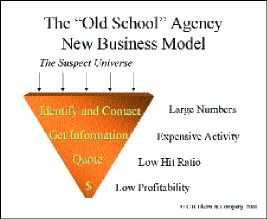
The chart (below left) describes the qualification process of the "late" insurance salespeople (may they rest in peace!) As you can see, obtaining information drives the entire process needed to quote. The yardstick of success is based upon the ability to deliver a "competitive quote."
You all know that the results of this approach are ... a 15% hit-ratio. Our industry has determined that this return on investment is no longer acceptable. Your carriers can't afford it, your agency/brokerage can't tolerate it, and your family can't prosper with it.
So, what is the answer? The development of a higher-level prospect that views us as consultative brokers.
Consultative brokers know that the development of a prospect depends upon a number of things. It is more than simply building a relationship with someone who will let us bid. Here are the key prospecting points of all successful consultative brokers.
 Establish a strategy. In most cases this strategy is fully developed before the first call is made. It is only after the strategy that the question is asked, "How will we get in?" This is the last question, not the first!
The strategy needs to address such issues as:
a. Why will we be of value to this prospect?
b. What are the resources they will need?
c. Where are the relationships that must be built?
d. How do we communicate our culture?
e. Who will be the team leader and gatekeeper?
f. How will we structure our presentation that answers all of the above questions?
Establish points of differenti-ation. Throughout the sales process, successful consultative brokerages differentiate themselves with services and resources. Many firms believe that this is enough to sway a client, but there is more needed. We must remember the difference between features and benefits.
Demonstrate the benefit. There is only one major benefit that clients must learn and understand. It is the benefit that answers the question: "How will your firm impact our total cost of risk?" Successful consultative brokers begin to craft the answer to that question early in the prospecting cycle. All of their efforts are geared toward showing the prospect specific ways that they are uniquely qualified to reduce these costs. Please remember that the impact on these costs range well beyond simply the price of the insurance policy.
Test the relationship. In a number of cases the prospecting cycle will stretch for an extended period of time. Some of these prospects may take 18 to 36 months to convert into clients. During this period consultative brokers regularly test their perceived value with the prospect. This is a very important step as it allows them to adjust strategies, improve relations, or bring in additional resources.
Keep the powder dry! Consultative brokers know that they will get only one good shot at a prospect. Therefore, they do not waste it. Consultative brokers do not use ammunition on prospects that are not fully matured. They are not willing to fire the ammunition of agency staff, carrier relations, or personal production time on a prospect that is not ready to value them. In these cases they understand that either there is more work to be done or they have a prospect that should be fired!
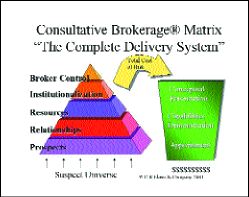
The effective practice of Consultative Brokerage® requires that only quality prospects be solicited. That is the cornerstone of Consultative Brokerage as it provides producers with a platform to attract and retain these quality accounts. It is not for every prospect--only the ones that will yield the largest revenues, best relations, and long-term profit possibilities. As the Consultative Brokerage Matrix shows, all parts must fit together in a seamless delivery system. The firms and producers who practice these principles are operating at a very high level.
I am constantly asked: "How many prospects should I have?" As a working broker, my goal was to obtain 25 prospects that fit my definition of a Consultative Brokerage prospect. I was never able to achieve this goal. The reason? I was too busy dropping clients to the bottom line. My last full year of production with a major brokerage firm yielded $350,000 of new revenues and fees of middle-market accounts. That is a testimony to the power of Consultative Brokerage. *
The author
Rob Ekern is president of C.R. Ekern & Company, located in Phoenix, Arizona. He formed C.R. Ekern & Company after 25 years as a highly successful broker. C.R. Ekern & Company works with regional and independent brokerages across North America providing Consultative Brokerage training. Consultative Brokerage is used to attract and retain quality middle-market clients. Visit www.CREkern.com for more information on Consultative Brokerage.