MARKETING AGENCY OF THE MONTH
Oswald Trippe and Company is committed to
protecting clients, employee-owners--and to growth
By Dennis Pillsbury
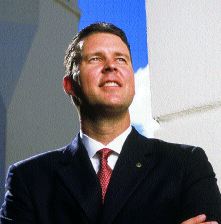
John Pollock, CIC, was named president of Oswald Trippe and Company, Inc., on January 2 of this year.
Oswald Trippe and Company, Inc. (OTC), Fort Myers, Florida, celebrated its 20th anniversary last year with nearly $12 million in revenue, well ahead of its original goal and in keeping with its plan to grow a minimum of 15% a year. The agency, whose humble beginnings trace back to 1981 in Gary and Gay Trippe's Fort Myers house, now has six offices in various south Florida locations staffed by 100 employee-owners.
The growth--planned and deliberate--has resulted from a combination of acquisitions and new business. The expansion started in 1983, with the addition of an office in Miami. "A producer had a niche program there, and it just made sense," explains John Pollock, president of OTC. "In addition, Gary had been president of a large agency in Miami and still had contacts in the area." OTC acquired a small agency in Naples in 1992, at the suggestion of one of their carriers, which knew that the agency needed help with markets. The Cape Coral office was the result of the acquisition of a small agency that needed markets. (That office has been consolidated with the Fort Myers office, but there are plans for a new Cape Coral office to be opened this year.) In 1997, "we were referred by another carrier to a father/son operation in Holmes Beach. The father planned to retire and wanted his son to be able to continue in the business. In 2001, OTC opened two additional branches in Weston and Sarasota. Weston is a high-growth area, attracting many new businesses and construction. We had been doing business in Sarasota from our other offices. When the timing was right and we hired the right person, we opened an office there."
Community involvement is key
Obviously from the above, OTC considers being part of the community an important part of its marketing. Community involvement is included in each producer's Personal/Business Plan. "For the most part, everyone is involved in community organizations, like chambers of commerce, Rotary, United Way or other organizations in which the producer has a particular interest," John explains. "We encourage everyone to get involved and give back to the communities that have supported us. That's part of what we do. It's one of the most effective ways to meet people and build relationships."
John continues: "Community involvement is just one of the important relationships on which we focus. There are four key constituents." In addition to community, the other components are insurance companies, clients and prospects and fellow employee-owners (30% of the agency is owned by an ESOP). "We believe that there should be a balance, with all four of these receiving equal attention and consideration."
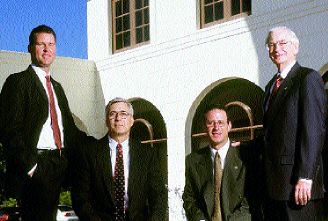 From left to right: John Pollock, CIC, president; John D. Belisle, CIC, senior vice president; Doug Fields, senior vice president; Gary V. Trippe, CIC, chief executive officer.
OTC also stands for "our total commitment," John continues, which is "to protect our clients and employee-owners while growing to 20/5 - 40/10." (That's $20 million in revenue by 2005, and $40 million in revenue by 2010.) "We believe that is consistent with our focus on the four key relationships. It makes it clear that they can count on us for the long haul. Growth is an important part of that for a lot of reasons. It means that we can continue to provide better products and services to our clients. It means that we can help our insurance company partners to meet their goals and objectives. It means we will have the funds to keep up with technology. It means that our employee-owners benefit financially, but also that they have a workplace where they can advance to whatever level they want to reach. It means that we will be able to increase the number of people working here and working for our communities."
Planning is equally important
"One of the core reasons for our success," John says, "is that under Gary Trippe's leadership, agency executives have become incredible planners. Every producer does a Personal/Business Plan that spells out his or her goals for the upcoming year. We've been doing this for about 10 years, after I served as the guinea pig. It came about," he explains, "after we were reminded that each person has a 75% better chance of accomplishing a goal when they write it down." The plans are given to John on October 1; he reviews them and then goes over each one with the producer during November and December. "Once finalized, the agency's overall plans for the year are shared with everyone. It really helps us be consistent in the way we operate. Producers and support people all are heading in the same direction."
He points out that "the personal part of the plan isn't required, but a lot of producers choose to complete that section. They'll include things like losing weight, cutting two strokes off their golf score or starting a family. A lot of them like to share personal goals. It helps to cement us as a kind of family, and we all enjoy sharing in personal successes as well as business successes."
John continues: "We really just concentrate on the basics. We're a traditional agency with 58% of our business coming from commercial lines, 32% from personal lines and 10% from employee benefits and financial services. We consider it part of our job to serve the needs of the community, so we don't set a premium or revenue policy minimum. We will write the small business owner's policy, the unit owner's policy and so on."
The business plan includes an outline of how the producer "will relate with those centers of influence that will help him or her achieve their goals. For example, we have producers who handle only personal lines. They ally themselves with real estate agents, title companies and so on and really provide those 'centers of influence' with excellent service. The real estate professionals know that a certificate of insurance will be there at closing. We make certain that happens." Thanks to this focus on service, OTC is rewarded with 100 new personal lines policies every week. The agency's retention ratio is approximately 95%.
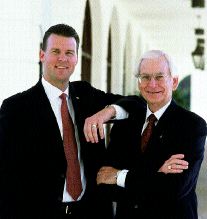 John Pollock, CIC, (left) took over presidency of the agency on January 2 from Gary V. Trippe, CIC, who continues as chief executive officer.
This focus on the basics is "enhanced by the planning process. It leads to a consistency of approach. Our clients, our customers, our companies and our community all know what to expect from us from year to year. We actually do a business plan with our insurance company partners to make certain that we're on the same page," John says. "We also present a kind of business plan--we call it a report of insurance--to our business clients. That document summarizes their coverages and also includes our recommendations. We meet with our clients on a regular basis with the goal of becoming their trusted advisor. For some clients, this may be monthly meetings and for others, less frequently. Others like the job we do, trust us to act in their best interest and want to see us only once or twice a year, or when there's been a change in their risk profile."
The consistency also carries over to the agency's work in its communities. For example, OTC started out as a participant in the American Cancer Society's Relay for Life. For the first three years, the agency had a team walking the laps. (The relay runs from 6 p.m. on Friday to noon on Saturday.) Family and friends of team members started showing up to help, and participation just kept growing. "Now we're a presenting sponsor," John says. "Our employee-owners made dog bone wreathes at Christmas, and they've hosted ice cream socials and organized car washes to help raise money."
He continues by noting "they are just as generous with their money as they are with their time. For the past six years, we've been recognized by United Way as the highest per-capita giver in the county, and we're in the top 10 for total giving."
"It's always best that you start at the beginning."
--Glinda, the Good Witch of the North, from the Wizard of Oz
"It all starts with the hiring," John says. "We look for individuals who want careers rather than jobs. The challenge is finding experienced people who want to have careers. Since we're growing, we constantly try to add new people. We use profile tests--Omnia and Caliper--to help us with our search. During the interview, we explain our culture--that we are a professional organization. We wear suits and ties every day, even in south Florida. We're not a high-pressure sales organization. We're a consistent organization that is always around. Gary engrained the attitude that 'while we may not get an account this year, we stay in front of the person, build a relationship and are there when the opportunity arrives.'
"Once a person is on board, we have a training program for everyone," says John. "We have an operations division that is dedicated to training. New hires also are assigned mentors."
Cultural immersion
Since everyone is an owner of the agency: "The financial results are shared with the staff. We have monthly meetings where we review our successes as well as our areas of concern. We share our ideals and visions for the future and recognize those people who are helping OTC reach and exceed its goals.
"Every quarter, we have a peer-recognition program," John continues, "where we recognize employees who have gone above and beyond. Anyone can submit an employee-owner's name for recognition. Five winners receive nice prizes like resort weekends or gift certificates, but we don't honor just the five winners. We also recognize all whose names were submitted. We read every submission and thank all of them for their efforts."
The agency also established an annual community service award that is given to one sales person and one support person. The award includes a $500 bonus to the person, plus a $500 contribution to the charity of the person's choice.
Learning provides an edge
"Learning is a big part of who we are. We've used a number of consultants and organizations to help us get better. Lee Knapp, for example, served as our sales manager for years. Gary and I both are responsible for books of business and aren't trained sales managers, so Lee came in to fill the void. She bills herself as the portable sales manager and has lived up to her billing. She uses role-playing and other techniques to reinforce the basics of sales etiquette and so on. It was a great opportunity for our produces to get one-on-one with an incredible consultant. We've also found Roger Sitkins to be an invaluable resource for learning and growing. Other organizations that have helped us include Assurex, CIAB and FAIA."
John notes: "We also have a Strategic Initiative Team that includes Gary, John Belisle and Doug Fields, both senior vice presidents and owners outside the ESOP, and me. The team meets every Monday afternoon for a couple of hours to work on strategic initiatives. Gary Hudson, a consultant, helps coordinate that effort, which is a very big part of the learning process."
Many of the employee-owners also are engaged in formalized education, pursuing the CIC, CPCU or ARM designations.
John concludes: "We're really a very basic sales organization. We recognize that the pipeline needs to be overflowing, so we have weekly sales meetings where each producer lists all appointments so we can coordinate efforts. Their progress is tracked every month. We have a President's Award for those producers who exceed their goals by more than 10%. It includes a bonus, plaque and dinner. Oh, and in case you wondered about how we grow by more than 15% every year, we require every producer to grow by a minimum of 15%. We've been doing that forever--or at least for the 20 years we've been in business." *
For more information:
Phone: (941) 433-4535
Web site: www.otc1.com