MARKETING
With agents and consumers as partners,
New America finds gold at the heart of under-served city markets
By Elisabeth Boone, CPCU
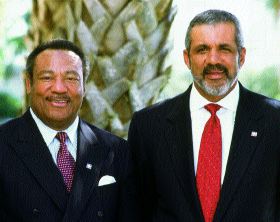
Bob Willis (left) is president and chief operating officer of New America Insurance Company; Hylan (Hank) Hubbard is the company's chief executive officer.
Those with a long memory or a grasp of history will recall the days of "redlining," when underwriters literally drew red pencil lines on maps to cross out urban neighborhoods they considered too unprofitable to insure. Citing poverty, crime, drugs, and decaying properties, insurers felt justified in taking a pass on most inner city communities.
Today, thanks to the combined influence of civil rights initiatives, legislative efforts, and social evolution, the practice of redlining is virtually extinct. In the late 1960s, the federal government stepped in with the FAIR Plan (Fair Access to Insurance Requirements) to provide a floor of protection to inner city property owners. Since then a few major carriers have launched outreach programs to help urban residents and businesses obtain needed coverages. Nationwide, however, many of these risks either lack adequate insurance or must acquire it through nonstandard markets, where prices are high and restrictions abound. This trend prevails despite the fact that many once-crumbling urban neighborhoods across the country are becoming livable, prosperous communities that reflect the rich ethnic diversity of America's changing population.
In this under-served market, good intentions don't necessarily produce good solutions. However sincere their efforts, most major standard carriers simply don't know how to address the needs of an emerging middle class comprised of urban ethnic minorities. Perhaps no one understands this better than Hylan (Hank) Hubbard, who views the situation from two important perspectives: his 26-year career with a major national stock insurer, where his last position was senior vice president of agency development; and his ethnic heritage as an African-American. "I attempted to diversify my company's agency force by appointing more urban agents, and I found it was very difficult to do for a variety of reasons, most having to do with the company's orientation and infrastructure," Hubbard says. "At the same time I was having conversations with Bob Willis, an attorney and former insurance commissioner of the District of Columbia, about urban and under-served markets."
As a former insurance regulator, Willis saw the issue as a lack of product availability, exacerbated by the lack of efficient carrier access to these markets. Both he and Hubbard concluded there was a business opportunity to tap this rapidly emerging middle class in urban communities. "Although a few insurers see the opportunity, most have not yet figured out how to solve the access issue," Hubbard says.
Hubbard and Willis did have a solution to the access problem. Together with other investors, they founded New America Insurance Company in Tarpon Springs, Florida, which opened for business in January 1999, with Hubbard as chief executive officer and Willis as president and chief operating officer. April 2000 saw the launch of an affiliate, New America Managing General Agency, whose president is veteran independent agent Peggy Reid. Of the New America Companies' five founders, Hubbard notes, four are ethnic minorities.
A mission and a plan
As Willis saw it, the challenge was not just to "sell" standard insurers on the merits of urban and under-served markets; the more important business objective was to help insurers penetrate those markets efficiently and profitably. "Our mission is to create access to emerging multicultural markets through the use of local independent agents. We will bring companies with a strong interest in growing these markets together with the agents and customers in those markets," Willis explains. "We see the gap that exists as primarily one of access rather than an attitude of risk avoidance. We're no longer seeing redlining per se; instead we're seeing frustration on the part of companies that really want to be in these markets but lack the tools to penetrate them efficiently."
Since the launch of New America, Hubbard and Willis have visited a number of company home offices, and what they've found has helped them understand why insurers' efforts aren't producing the desired results. "What we typically find is a very small department within a large
company that focuses on multicultural/ethnic/urban markets," Hubbard says. "They assign one or a few people the responsibility for seeking out opportunities in the market and then marshaling resources in underwriting and marketing, and trying to connect the two pieces." For a variety of reasons, Willis notes, this approach is not producing the level of market penetration these companies seek.
"The agents in these markets are small, and few have the training and experience required to deal successfully with traditional companies," he says. "Too many have had a short-lived relationship with a carrier because the agency has been unable to support the insurer's growth requirements. On the company side, there's a tendency to apply traditional solutions to nontraditional problems. At New America, what we do is create a connection between under-served markets, the agents in those markets, and standard carriers."
A new breed of MGA
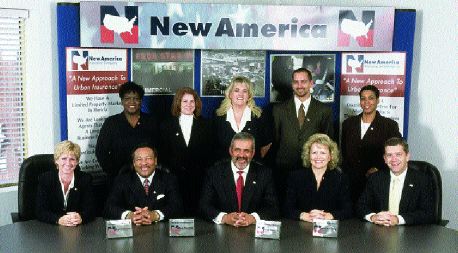
How do they forge this vital connection? The linchpin of their strategy is New America Managing General Agency. In the substandard markets where many under-served agents do business, Hubbard observes, intermediaries often act simply as conduits, passing through submissions to any market that will accept them. "Our model is different because we act as an extension of insurers' marketing and under-writing infrastructure," he says. "We focus on agency selection, training, and development. Even more important, we control the flow of business from the outset so we can ensure appropriate risk selection."
With Peggy Reid at the helm, New America MGA is making impressive strides in bringing together under-served urban agents and their clients and some name-brand insurers in the standard and preferred markets. Here are the companies the MGA represents and the products they offer:
*Travelers Commercial: businessowners, commercial automobile, general liability, umbrella, and workers compensation
* First Floridian/Travelers: preferred to nonstandard auto
* American Colonial: flood insurance
* New America Insurance Company: preferred home-
owners, standard homeowners,
and dwelling fire
New America MGA is no pie-in-the-sky venture that's determined to find a standard market for every urban risk. "We've been around long enough to recognize that, given the vast dimensions of this emerging multicultural and urban market, some pockets still will have major underwriting issues, and this business will end up in residual markets," Hubbard explains. "However, there's another large group of accounts that fly slightly under the radar of most traditional companies, and that are good, profitable risks. We're trying to fill the gap for those accounts, especially on the commercial side, that aren't getting the kind of marketing and underwriting attention they deserve."
Flexible and responsive
It's common to use size as a measure of success, but Reid offers a different perspective on New America MGA. "We're small and agile, so we can react quickly; we don't have layers and layers of management," she comments. "For carriers, we're their link to efficient distribution in our urban markets." And for agents, the MGA represents an opportunity to expand beyond the confines of the nonstandard market. "Our under-served agents are not unsuccessful," she asserts. "They're successful producers, but they operate primarily in the residual and nonstandard arena. We step in and say, 'We want to take you to the next level, to move you into standard and preferred markets.'"
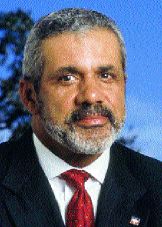 During Hank Hubbard's 26-year career with a major national stock insurer, he saw the need and opportunity to market to urban and under-served markets.
"At New America, what we do is create a connection between under-served markets, the agents in those markets, and standard carriers."
--Hank Hubbard, CEO
New America Insurance Company
At year-end 2001, Reid says, the MGA's field force comprised some 250 licensed agents. "At least half of our agents come to us through a referral from another agent who is already working with us," she explains. "Also, members of our marketing staff literally drive around urban communities, find agencies, and knock on the door. We explain our mission and explore whether we can work together, whether these agents are willing to undertake the commitment to the training, education, and professional development they need to be successful in standard and preferred markets."
The proof is in the paper
Although the MGA is the centerpiece of New America's strategy, New America Insurance Company is a key element in the effort to build a bridge to standard markets, Hubbard points out. "Our insurance company serves as a supplemental vehicle to the markets used by the MGA," he explains. "It helps fill voids where we can't get products from other companies, or where their products don't meet the needs of our market. Then we use New America Insurance Company to supplement those relationships." Hubbard delivers the take-home point. "This is a great way for us to prove the validity of our strategy," he comments. "It's fine for us to tell standard companies that our accounts are profitable opportunities--but nothing speaks louder than saying we'll write these risks on our own paper. This takes the pressure off the companies our MGA represents because they know there's a relief valve for spread of risk."
With premium volume currently at about $13 million, New America Insurance Company is a small but healthy going concern. Moreover, it has the resources to develop coverages that meet the needs of its agents and their clients when those needs can't be met in the standard market. "If we want to create a product that's more responsive to our market, we can do it through our insurance company," Hubbard says. "Most important, through New America Insurance Company, we think we can demonstrate convincingly that an underwriting profit can be made in urban markets when they're handled correctly."
Solid and stable
As veteran industry professionals, Hubbard, Willis, and their fellow investors understood that, for all their interest in penetrating urban markets, standard and preferred insurers would give close scrutiny to the structure and resources of the New America organization. "Our financial base is very solid," Hubbard says. "Our internal controller, John Gross, is the former chief financial officer of a major fast-photo processing chain. Our external auditor is Arthur Andersen. We use the law firm of Colodny, Fass, Talenfeld, Karlinsky & Abate, which is deeply rooted in the insurance industry and has a thorough understanding of regulatory issues. Bob Willis handles those issues internally." Guy Carpenter, the largest reinsurance intermediary in the United States, and its affiliate, Durdan Consulting, provide guidance in strategic and business planning, reinsurance placement, and product development.
 Peggy Reid, a veteran independent agent, is president of the New America Insurance Company's newest affiliate, New America Managing General Agency.
On the operations side, "We hired underwriting talent that has depth of experience in both personal and commercial lines," Hubbard continues. "Our systems manager has a solid background in insurance, and with BIPT (Better Insurance Processing Technology) we developed an Internet-based policy processing and management system. We use the services of ISAC, a top-notch claims services company." In sum, Hubbard says, "We've assembled a very seasoned and experienced team. We know how to deal with the specific issues involved in making sure that what goes on between the urban/under-served agent and the standard carrier is done the right way."
Getting a jump start
For a new insurer, building a strong agency force and developing a solid book of business require focus, commitment, and skillful deployment of resources. New America Insurance Company gained an edge by beginning operations as a residential property takeout insurer for the state of Florida's joint underwriting association. The JUA was established in the wake of Hurricane Andrew, whose devastating losses spurred a major pullout of standard homeowners carriers.
"The state created innovative takeout programs to bring insurance capacity back to the Florida marketplace," Hubbard says. "Participating in a takeout allowed us to 'jump start' our company's revenue, and it provided a large base of agents to begin operations. From that foundation, we're building a cadre of agents who buy into our strategy and are committed to the training and development they need to become true insurance and financial centers in their communities."
Chartered and licensed in Florida, New America Insurance Company started out writing business in the heavily urban, multicultural Dade/Palm Beach/Broward County area; currently the company is focusing on appointing agents and building volume in Jacksonville, Orlando, and Tallahassee. To Hubbard, Florida is an excellent launch site for an effort he ultimately wants to introduce nationwide. "Beyond the takeout opportunity, Florida has all the characteristics of the markets we're targeting: a large number of urban areas with diverse ethnic populations and little or no access to standard insurers."
Commitment to the community
Although he firmly rejects notions of social engineering, Hubbard understands the vital role a professional independent agency force plays in helping urban communities thrive. "When you do business in urban markets, you realize that the quality of risks is mixed, just as it is in any other market; and you also know there are long-standing issues of crime, unemployment, and the other things standard carriers worry about," he says. "To operate successfully in our markets, we need some sets of eyes and ears in the neighborhood. Our agents live and work in their communities. They know where the problems are, and they know where things are changing for the better, so they can help us select high-quality risks."
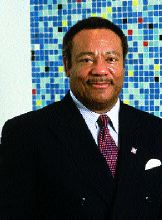 An attorney and former insurance commissioner of the District of Columbia, Bob Willis says New America's mission is to create access to emerging multicultural markets through the use of local independent agents.
As part of its commitment to the communities it serves, New America created the Community Empowerment Program, which will provide scholarships for high school students to obtain their agent licenses and then help place students in agencies that are committed to enhancing their insurance education. New America will also offer grants and a mentoring program for agents who want to open their own agencies.
Community involvement doesn't stop there. New America belongs to the Institute for Business & Home Safety (IBHS), an initiative of the insurance industry to reduce deaths, injuries, property damage, economic losses, and human suffering caused by natural disasters and other hazards. "Our market has a lot of first-time insurance buyers, or people who've been obtaining insurance through residual or nonstandard channels," Hubbard explains. "As a member of IBHS, working through our agents and community-based organizations, we'll find ways to educate consumers about improving the safety of their homes and businesses. At the end of the day, everybody benefits, because the quality of the business has improved."
A top priority on New America's to-do list, Hubbard says, involves participation by the insurers represented by the MGA. "We want to encourage the companies that provide insurance in our communities to use vendors in those communities as a way of recirculating dollars," he says. "For example, if you're a national carrier, you have contracts with auto glass companies or glaziers for homes and businesses. Why not replicate those kinds of arrangements on a smaller scale in urban communities? Why not offer these contracts in the markets you want to penetrate, which may become the prosperous communities of the future?"
Shape of the future
Speaking of the future, what kinds of initiatives will New America pursue over the next few years?
First, "We'll complete the beta in Florida, meaning that we'll be offering a full complement of products and services," Hubbard responds. "Right now we have homeowners, personal auto, and flood, and we'll soon launch our own personal umbrella policy. We've just signed on with Travelers to offer a whole platform of commercial products for small and medium-sized businesses. In the future we plan to round out our product offerings with life and health coverages."
A second major initiative will be to secure the next level of financing by forming strategic alliances with insurance company partners. "This will enable us to expand our product line, to grow the MGA, and to prepare for entry into additional states," Hubbard says.
How does the future look to Hank Hubbard and the other principals in New America? "I have a vision that in the not too distant future, wherever New America has been, you'll see two things," he responds. "First, you'll see minority and urban independent agencies that have become thriving financial service centers in their communities. Second, you'll see major national carriers routinely achieving their profit and growth objectives in these multicultural markets. The demographic changes in the country all point toward a 'new America' by 2020," Hubbard asserts. "The proactive steps we're taking now will allow New America and its company partners to take advantage of these exciting changes." *
For more information:
New America Companies
Tarpon Springs, Florida
Phone: (877) 934-2947
Carriers: E-mail: Hank Hubbard (hhubbard@newamerica-ins.com)
Agents: E-mail: Peggy Reid (preid@newamerica-ins.com)
Investors: E-mail: Bob Willis (newamerica@rmwillistar.com)