PROTECTING THE PIPELINE
Technology group aids legislators in efforts to keep
insurance information flowing smoothly
By John Chivvis
 There is no doubt that technology advances have helped agencies streamline operations, expand business, and increase customer service. From the World Wide Web and the Internet to e-mail and e-commerce, carriers and agencies alike have benefited from the technological improvements to insurance information distribution.
But with the explosion of Web-based technology used for business, federal legislators feel the need to guarantee consumer privacy, as well as the safety and integrity of each individual's personal and private data by regulating the ways information is transmitted, secured and stored. In the insurance industry, legislation initiated by well-intentioned, but technologically unsophisticated, lawmakers could drastically affect the interaction of communication and data from carriers to agencies, from agencies to staff and from staff to consumers. Ensuring that members of Congress understand the technology used by the insurance industry as well as how legislation will affect the industry from the company down to the policyholder, is the daunting task of the Washington, D.C.-based Insurance Technology Coalition (ITC).
Sandy Clark, ITC executive director, says that in the past, insurance companies and technology vendors implemented solutions with the data residing on company hard drives
and mainframes. However, with the
e-commerce explosion, business models have changed and now "information rich" solutions are providing all kinds of information through a number of different methods including Web sites and e-mail. "And now, Congress has gotten into the act, wanting to regulate what's going on in business on the Internet--when, how much, and even what industries will be affected," says Clark.
According to Clark, the ITC's purpose is to give insurance technology companies, as well as agents and companies, a voice in Congress. "When we met with members of Congress and various committees, we'd ask where they go to get information on insurance technology," says Clark. The blank stares that Clark received as his answer reinforce the idea that while these Congressional leaders and staff members had the public's best interest at heart, they weren't grounded in the specifics on technology matters and issues.
"It really is all about the technology," says ITC member and technology consultant Steve Anderson. "Technology permeates our business--we offer online customer service, we communicate through e-mail, we rate a policy in real-time," he notes. That being the case, Anderson says that the ITC serves to help legislators understand why technology is implemented, by improving their understanding of how pervasive technology is for the business side of insurance. Part of the ITC's role is to facilitate meetings and presentations by ITC members for members of Congress, their committees and staffs, and even other lobbyists on insurance technology topics that have a bearing on current legislation.
Applied Systems is also a member of ITC, and according to Doug Johnston, executive vice president of e-commerce, the opportunity to educate legislators on insurance technology and technology processes during discussions of potential legislation is invaluable. "Usually, it's not until months after a law is passed that its full impact and cost to our industry can be determined," he says.
Anderson agrees, saying: "Most lawmakers don't understand the technology and therefore cannot anticipate the potential impact of their legislation." In fact, he says that too often members of Congress will draft, debate and vote legislation into law without much insight into the actual impact of e-commerce aspects of the insurance buying and selling process. The concern that members of the ITC have is that without someone in the insurance technology world voicing their opinions, laws could be passed that would severely, if inadvertently, hinder and constrict the way agents conduct business with their carriers and with their customers.
According to Clark, a good example can be seen in the introduction in Congress of a recent anti-spam bill. The legislation started out as a means to eliminate unsolicited e-mails, a seemingly good idea, especially to combat pornographic e-mails and advertising. However, without the proper information and understanding of insurance technology and e-commerce business processes, the initial version of the bill would have stopped all electronic communication between agents and prospects and even their current customers. "Agents wouldn't be even be able to communicate information back and forth with their companies via e-mail," he explains.
Another example is that of privacy, especially with respect to database security. "We have more information on people than any other industry," says Anderson. The issues that arise are how to handle the information, how it can be used, how it can be accessed and how it should be secured. "It's a good goal to have, to not be able to hack in and get information," Clark acknowledges, "but the bill in its current form wants to hold database owners and the company's officers personally responsible." The costs associated with database management and security would adversely affect not only a carrier's bottom line but would also be passed all the way down to the consumer.
By putting legislative bodies and committees in direct contact with individuals who are knowledgeable about insurance technology, both sides are better able to understand what the true purpose of the legislation will be and its impact. "We're proactive in that we are trying to help lawmakers understand how e-commerce will work with insurance technology and its benefits to end users," says Clark.
That understanding comes from ITC efforts to keep members of Congress and their staff apprised of insurance technology, business models and thought processes sooner, rather than later. Clark says that keeping lawmakers better informed helps develop a stronger sense of trust--increasing the likelihood of getting what is best for the industry. "Our goal," says Clark, "is to get the legislation right at the beginning of the process--not waiting to fix it after it becomes law."
It is important to have these "techies," as Johnston calls them, be able to provide insight into the industry. Clark adds that it is good to have technology experts at the heart of a bill's development, "because they can best define and implement the technology."
While there are other insurance and technology lobbying efforts occurring on Capitol Hill, the ITC is the only group specifically focused on insurance technology. The ITC's membership is made up of a wide spectrum of technology vendors and service providers of contrasting and overlapping markets. The ITC's membership includes software vendors such as Applied Systems and AMS, as well as Internet technology companies like Agency Revenue Tools and newer technology companies like Fusura (which represents AIG, Prudential and Kemper). Johnston says "people who participate in ITC meetings check their egos and their competitiveness at the door.
"These are issues that affect us all," Johnston continues, "so whether it's AMS or Applied, it doesn't matter--and that's the way it should be." In fact, Johnston counts one of the ITC's strengths to be its broad base of technology experts, saying, "It's great to be able to have different perspectives for different issues."
Even though ITC is geared toward technology companies, Clark, Johnston, and Anderson all agree that agents are the beneficiaries of these efforts. One benefit comes from the role ITC takes as a communication conduit or pipeline. As information is gathered from Congress or legislators, ITC runs it by its members. They in turn disseminate it to their legal teams and to their software development groups to help ensure that new applications are compatible with current and proposed legislation. Johnston explains that information is passed on to user groups as well.
Anderson believes that for most agents, the effect of legislation "runs under their radar," as it does for most people. Then, the reaction to the effects of a new law is just that--a reaction. "As members of the ITC," says Anderson, "we want to prevent the problem from happening in the first place, not provide a solution for the problem."
Regulation of the Internet, as it relates to business and e-commerce, is getting closer. Data transmission, information security, and even taxation are currently under discussion in the House, the Senate and all points, offices, and committees in between. While ITC and its experts are working closely with members of Congress on Capitol Hill, Clark says that agents have a vital role to play. "Agents are the pivot point," he notes. "They need to be thinking about the future of their businesses by looking 'upstream' through their vendors and technology providers to their carriers to see what is happening and what changes are going into effect."
Clark points to agents as key figures in their community, due to the nature of their work. "Agents have strong connections to their community," he says, "and should have strong connections to their legislators, both local and federal." Anderson agrees that agents need to be more aware of what's happening on the local and state level with an eye toward the federal. "I would recommend that agents ask their legislators about these issues," he says.
In the same way that the ITC is a resource for Congress, Congressional staffs, and lobbyists on the federal level, Anderson says agents need to be a resource for their legislators, providing information, assistance and understanding either through ITC or by direct contact. Johnston adds that agents have the unique ability to explain to legislators the business workflow that goes into the selling and processing of insurance. "It's just a system that is difficult to understand," he says.
The fact still remains that the insurance industry needs to be aware of impending changes to e-commerce processes. "The Internet is a pipeline, no different than any other delivery mechanism," says Johnston. Clark adds that that while e-commerce is still commerce and should not be treated any differently, Congress is still attempting to regulate the use of the Internet for business. "It's not a question of 'if'; it's a question
of 'when.'" *
The authors
John Chivvis is a Texas-based writer who specializes in topics of technology implementation. His work has appeared in a number of national and regional publications.
Bill Jenkins has worked extensively with independent agents for the past 16 years in the areas of marketing, advertising, communication and technology.
MAKING A "HOUSE" CALL ON CAPITOL HILL
By Bill Jenkins
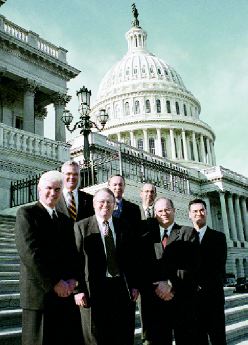
An important part of working with Congress is having your issues clearly understood by members of the House, the Senate and key Congressional staff. ITC members from across the country recently converged on the U.S. Capitol Building in Washington, D.C., to deliver a briefing to this important audience.
ITC members in attendance included: Steve Anderson, technology consultant; Bob Duggan, AVP of MIS, Safety Insurance Company; Doug Johnston, EVP of Company Products and E-Commerce, Applied Systems; Michael J. Krassner, VP Field & Tele-Sales Force, AMS Services; Dan Loranger, CIO, Safety Insurance Company; Pat Miller, AVP EDI development & marketing manager, Chubb & Son; and Asa Pike, president, Agency Revenue Tools.
 ITC Executive Director Sandy Clark explains the technical aspects of exchanging critical information--data and otherwise--in a business-to-business environment on the Internet.
The purpose of the briefing was to provide an overview of technology issues that impact the insurance industry and to demonstrate some of the specific technology applications that enable transactions to occur over the Internet. After ITC Executive Director Sandy Clark set the stage, ITC members gave a series of presentations on a variety of critical agency/company/customer technology issues including, batch and real-time transactions, the importance of industry technology standards, security and confidentiality, and the consumers' demand for 24x7 access to their own information. The presentations placed special emphasis on the important role of technology in eliminating redundancy and duplicate entry, thus reducing cost--ultimately resulting in increased customer satisfaction.
 ITC member and EVP of Company Products and E-Commerce for Applied Systems Doug Johnston demonstrates some of Applied's latest technology to help Congressional members and staff better understand insurance transactions and the means by which they occur.
Congressional staffers who had, in fact, requested the session, appreciated the presentations. According to one of the attendees: "The decisions we make in Congress affect the lives of every American. It's important that we have a full understanding before we act. Everyone has insurance--that's why this type of briefing is so valuable. I hope it's the first of many."
This sentiment was echoed by Doug Johnston, one of the ITC presenters, who said: "We're here today to help head off a potential problem or misunderstanding--before it happens. It's like that old adage about 'an apple a day keeping the doctor away. ...'"
And yes, the ITC does make House calls.