MARKETING AGENCY OF THE MONTH
Wisconsin's oldest independent agency reinvents itself in a bold shift of culture
By Elisabeth Boone, CPCU
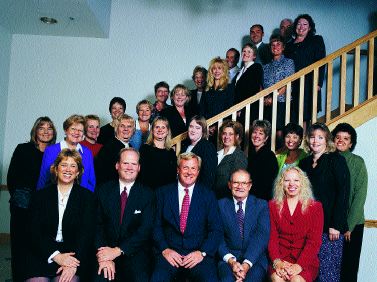
The staff of the 152-year-old Fitzgerald, Clayton, James & Kasten, Inc., in Milwaukee, Wisconsin, treasures the agency's tradition while eagerly embracing the changing marketplace.
Four generations of your forebears have been prominent figures in the insurance industry, some as company executives and others as the owners of leading independent agencies. You're the fifth generation to take over the reins of a family agency that opened its doors more than 150 years ago. The agency is respected, prosperous, and comfortable--but in today's complex and challenging marketplace, is that good enough?
For some agencies, the answer might be yes. That wasn't the case, however, at Fitzgerald, Clayton, James & Kasten, Inc., Wisconsin's oldest independent agency and one of the largest in its home city of Milwaukee. Tradition has its place, but today's market realities demand a laser-like focus on fundamentals coupled with bold new strokes to pull ahead of the crowd.
If anyone could be said to have insurance in his blood, it's Todd James, chairman and chief executive officer of Fitzgerald, Clayton, James & Kasten, Inc. Although he didn't start his career with the family agency--he first served stints at Lloyd's, Aetna, and Chubb--James was more than ready to come on board in 1987, when his father, Charles V. James, purchased Fitzgerald, Clayton, Noyes & Kasten, Inc. Today he presides over a firm with total commission income of
$4 million, 32 employees, and a carefully crafted strategy for pursuing profitable niche business.
Todd traces his insurance lineage back to the 1800s. His great-great grandfather, Alfred James, served as president of Northwestern National Insurance Company in the late 1880s; he was succeeded in this position by his son, Alfred F. James, and then by his grandson, Charles D. James, who was Todd's grandfather. Todd is thus the fifth generation of his family to work in the insurance business in Milwaukee.
Likewise, Fitzgerald, Clayton, James & Kasten has roots in the Milwaukee insurance community that date back to well before the Civil War. In 1955, George H. Russell Co. merged with Norris & Fitzgerald to form Norris, Fitzgerald & Russell Co., Inc. The Norris & Fitzgerald firm traces its origins back to 1850. In 1962, the agency merged with Blatz-Kasten and adopted the name Fitzgerald, Clayton, Noyes & Kasten, Inc. In 1987, the firm was purchased by Charles V. James, and the present name was adopted.
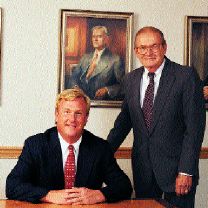 CEO/Chairman Todd James (seated) is the fifth generation of the James family to work in the insurance industry. His father (standing), Charles V. James, purchased Fitzgerald, Clayton, James & Kasten, Inc., in 1987 and now serves as chairman emeritus.
Now settling into its gleaming new headquarters building in the suburb of Mequon, just north of Milwaukee, Fitzgerald, Clayton, James & Kasten is deftly blending its proud heritage with a commitment to excellence that permeates every level of the organization.
Changing the culture
It would be easy for a long-established, highly respected agency to simply keep on doing the things the way they've always been done. It's a tough market out there, though, and just being big and old is no longer any guarantee of an agency's success. How did FCJ&K make the crucial transition from business as usual to leader of the pack? "When I became chairman and CEO in 1996, we saw a need to change our culture," Todd James responds. "We had hit a plateau that only one out of 10 agencies actually breaks through, where you stop operating as a family-run business and start to become a disciplined and focused insurance services organization."
Enter Roger Sitkins, agency management coach. "In 1997, I attended a Sitkins seminar in Madison, and as I listened to Roger, I became very intrigued with the path he laid out," James continues. "I thought it would be a great avenue for our agency to venture down. At that time Roger was promoting an exercise known as the Lifeboat Drill, in which you have to decide which members of your agency team to put on a lifeboat and which to leave behind. We did the drill when I returned to the office, and it turned out that there wasn't room in the lifeboat for one of our partners, who was a shareholder and one of our largest producers. So one of the first things we did was invite him to go on his way, and over the next 18 months we turned over a third of our staff." Over the last year and a half FCJ&K has added nine new employees to its staff and plans to add three or four more. The total of new hires will be five producers, two people in risk services and loss control, and the rest in support positions.
Top-down commitment
These measures, James says, "were our first steps toward changing the agency's culture and getting it on track to build the kind of team we needed to go forward. At the same time we realigned our management responsibilities and positions. We put everybody through The Kolbe Concept® process (a psychological assessment profile that measures a person's instincts vs. his/her learned behavior). We wanted people to spend 80% of their time doing the things they had a passion to do. This was a very important part of the restructuring we did to break through the plateau."
Adds Richard Twietmeyer, president and sales manager, "None of the things we do now would have been possible unless we had gone through that metamorphosis Todd just explained. We carry out our mission and operating philosophy by adding value, and that's what our culture is today. Before we made these changes, we were doing nothing to distinguish ourselves from other agencies and brokerages."
The agency's business development coordinator, Patty Andree, says management's commitment to excellence was clearly evident when she interviewed for her position in the spring of 2001. "I saw immediately that management had a philosophy they truly believed in, so I knew it was going to work," she says. "When I joined the agency, I saw the owners doing the same things they were encouraging us to do."
Restructuring for growth
Phase two of FCJ&K's cultural change initiative was to restructure its operations in a way that would support its commitment to become a trusted adviser to clients and add value to every encounter and transaction. "After we made changes to our team and realigned responsibilities to enhance our relationships with clients, employees, and companies, we realized we needed a new direction for our organizational structure," James says. "We created two limited liability companies, one on the property/
casualty side and one on the employee benefits side. We aligned with four P-C agencies and four employee benefits agencies. This gave us access to larger markets and new markets, as well as more clout with our carriers, which benefits our clients and prospects."
FCJ&K's operations are conducted through five departments: high-end personal lines, commercial lines, small business, professional (including products for the health care industry), and employee benefits.
To achieve growth in revenue and other critical indicators, an agency needs to invest in its most important resource: people. "A key part of our cultural change initiative is to help our employees grow and achieve their career objectives," James says. "We fully support professional education. As we add value to our employees, they add value to our clients and prospects. We want to be the best agency not only for our clients, but also for our employees. We strive to be the place where people want to work in the Milwaukee insurance business."
Building a sales infrastructure
A vital piece of Fitzgerald's cultural change initiative was to systematize the selling process, to give producers and the entire agency a clearly defined track for their activities. "We had salespeople, but we had no sales infrastructure," Twietmeyer observes. "That's the case with most agencies. Thanks to the strategies and techniques we've learned from Roger Sitkins, we now have a sales training system and a sales structure; that's why we're bringing in five new producers. We no longer market by cold-calling; we use centers of influence like attorneys, accountants, third-party administrators, and associations. When we call on a prospect, we don't try to quote the business; we set ourselves up as a point of comparison and then dissect the prospect's current representation."
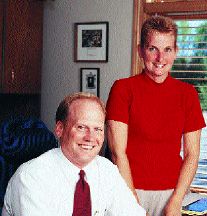 Richard Twietmeyer (seated) is agency president and sales manager, and Patty Andree (standing) is business development coordinator.
This new approach, Twietmeyer says, "not only helps us get agent of record letters; it's also taken our closing ratio from 25% to 78.5%." Producers at FCJ&K now "go paperless" when making calls, he adds. "As of the beginning of this year, most of our producers take a laptop instead of papers, and they make a PowerPoint presentation off renewal."
At FCJ&K, every employee is encouraged to identify centers of influence. "We ask our employees to be involved in the community, and by doing so they develop relationships that help generate new centers of influence," James comments.
Twietmeyer and James credit Sitkins with showing them how to take the agency from vendor to trusted adviser by using his Ten Great PlaysTM. These are simple (but not easy) strategies to help an agency build a sales culture from the top down. Service Hand Off, the first play, call for producers to turn over all accounts to account managers for service; this frees producers to do their job, which is to bring in revenue by acquiring new business. "At first this was hard, but once we got over the hurdle, things started to snowball," Twietmeyer comments. "We began to use other plays: trading down smaller accounts, setting a minimum account size. As our business development coordinator, Patty was very instrumental in making that process work."
Adding value
Over the years, the phrase "value-added services" has taken on the hallmarks of a cliché: almost everyone uses it, and almost no one is sure what it means. It's also a highly subjective term. At FCJ&K, adding value means just that: doing things that separate the agency from the rest of the pack by "wowing" clients with services they've never gotten before. Carla Borda, senior vice president in charge of the professional department, which serves health care clients, describes a value-added service her unit created. "In listening to our clients talk about what would make their jobs easier, we often heard that they would like an effective way to communicate with each other," she explains.
"We set up a network via the Internet called the Midwest Healthcare Alliance (MHA), which is a free service to our customers. If a client needs help dealing with a particular issue, we can connect him or her with another client who has experience handling that situation. The site has a bulletin board, and we send our clients e-mail alerts about issues in the industry, case law developments, and other information. Through the site, our clients can network with strategic partners we've set up for them: attorneys, accountants, and other professionals. The health care industry is changing on almost a daily basis, and the MHA Web site has been very well received," Borda comments.
"Premiums on our professional health care business are almost
$11 million," Twietmeyer notes. "We're a big player in the state, and the MHA Web site is a significant value-added service for our clients. In choosing niche markets to pursue, we look for those that recognize value and are not going to look upon a representative of that niche as a vendor; that's how we used to operate. We seek those niches that want to deal with a trusted adviser that brings value to the table and differentiates itself."
What's more, "Today we have risk management expertise both in-house and through outside consultants," Twietmeyer explains. "Through another entity we can offer our clients human resource services like writing employee handbooks and preparing benefit statements. We have exclusive rights in Wisconsin to a system called Compliance Checks that will review a client's records to ensure it's in compliance with federal and state regulations. We recently began to put employee benefit plan documents online for our clients. By providing these kinds of value-added services, we're raising the bar for our competitors."
Raves for reinvention
How do all these changes look--and feel--to FCJ&K's employees?
Jane Berndt, account manager in the commercial lines department, joined FCJ&K in August of 2001 with more than 20 years of agency experience. "One of the big differences I've noticed is that when management talks about assisting a client in, say, reducing workers comp losses, they go out and hire people who specialize in that area, so now we have loss control people in-house who can work with our clients. Other agencies may just use the loss control people from their companies. This agency goes the extra step to deliver value."
Another big difference between FCJ&K and other agencies, Andree remarks, is that employees truly function as a team. "If Carla is working on an account and needs help with personal lines insurance, she brings in a producer from that department. They work hand in hand, and she never has to question whether the job was done, because she knows the producer will follow through."
Adds Borda, "From what I've seen in other agencies, there's more competition among producers; they don't want to let go of an account and bring in someone else. Here it's the total opposite: We want as many people as possible to get to know our clients. When I'm working with a client, it's not uncommon for me to bring in two or three employees from other departments."
To ensure that everyone involved in an account knows what activity is taking place, the agency uses a "client binder" to which everyone has access via computer. "The binder has all the information on the account--renewal dates, X-dates, where the account originated, activity by employee, and action steps coming up for each employee," Andree explains. "The binder is also the place where we log testimonials, and it's a tool we can use to obtain referrals."
 FCJ&K's newly established Risk Services Department is headed by Joseph Bansemer (standing). Seated (left to right) are Brian Kleinmann, account executive; Charles James; Carla Borda, senior vice president; and Margaret Gloudeman, risk analyst.
The high level of trust among FCJ&K team members owes a great deal to the agency's commitment to open communication. "Our value-added philosophy is reflected in our day-to-day operations, and we make a point of communicating clearly to employees about our direction," James remarks. "Everyone knows where we're going and is helping us get there."
Borda agrees: "Our direction is something that we share not only with our employees but also with our clients and prospects, as well as our carriers and centers of influence. Everyone we do business with knows what we're doing and how we operate."
How do all these changes look from a producer's viewpoint? Marty Chipps, an account executive in the employee benefits department, joined Fitzgerald in February of this year. Twietmeyer had recruited him four years earlier; but at that time Chipps, who was a marketing representative with the Principal Financial Group, declined the offer. "As a vendor for Principal, I had the opportunity to call on hundreds of agencies across Wisconsin, and the common theme was 'product and price,' moving from fire to fire 90 days prior to renewal," Chipps says. "Four years ago, FCJ&K was very little different from the other agencies I called on."
When Chipps and Twietmeyer visited again in January of this year, he says, "I was amazed by the change in the way the agency did business. I was told, 'Marty, you bring a unique set of skills and abilities that will be attractive to our existing clients; and as we focus on widening and deepening our existing relationships, your skills will be invaluable.' That told me a lot about the agency's business philosophy, and it sold me on becoming an employee."
Celebrating success
Being the best isn't easy; it requires an unremitting effort on the part of every member of the agency team. At FCJ&K, though, working hard isn't supposed to be torture; quite the contrary. "We want what we do to be fun, and we celebrate our successes," James remarks.
"We recognize a Salesperson of the Month for bringing in the most new business and referrals," Andree says. "We also honor the Star Employee of the Month, who is chosen by peers for going beyond job duties and doing something extra to add value. This is a way for everyone in the agency to earn recognition and see how his or her efforts contribute to our success."
With its management and staff realignment, its organizational restructuring, and its top-down commitment to adding value, FCJ&K clearly has positioned itself to make the crucial leap from its comfortable plateau into the rarefied air of high performance. It's equally clear that the agency's pursuit of excellence isn't a once and done exercise. "We're not finished," James asserts. "There's a lot more we want to do, and it all comes back to differentiating ourselves and gaining competitive advantage."
If proof were needed that this dynamic agency is doing things right, it was selected Agency of the Year at the Sitkins 100 meeting in Phoenix last March--an honor not casually bestowed, as anyone who knows Roger Sitkins can testify.
Andree sums it up: "We're a 152-year-old agency that's brand new," she says. "We've completely remade ourselves. We want to honor the tradition of our past, and at the same time continue moving in new directions." *