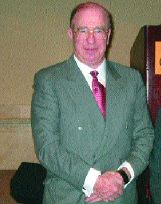
 Lord Peter Levene
Lloyd's first chairman from outside the insurance
industry describes the road to "transparency"
By Phil Zinkewicz
The United States continues to be Lloyd's largest single market, accounting for approximately 40% of Lloyd's business, with premium volume up 15% in 2002 to a new high of $8.2 billion.
Lord Peter Levene
In January, as the year had just begun to unfold, Lord Peter Levene, newly appointed chairman of Lloyd's of London, chose to make his inaugural speech in the United States. The venue was a luncheon held in New York and sponsored by the Association of Professional Women in Insurance (APWI). Chairman Levene chose the occasion to focus on the "unique relationship between the U.S. and European insurance industries," arguing that "the European insurance sector plays a greater role in the United States than other comparable European financial services and manufacturing industries." But more of that later.
The appearance of Lloyd's Chairman Levene at this luncheon was significant from a number of standpoints. First, Lloyd's of London, still stinging from past problems regarding now-resolved lawsuits by Names, has embarked upon a road to "transparency," attempting to shed the market's 300-plus-year image of an "old boys club," where complex insurance and reinsurance arrangements were struck in smoke-filled rooms far removed from the glaring eyes of regulators and the press. Second, it was clear from Chairman Levene's speech, and in a subsequent interview with this reporter, that Lloyd's syndicates, as major surplus lines underwriters in the United States, are prepared to take advantage of the current hard market, where even traditionally standard risks are moving into the specialty lines arena. And third, the Lloyd's chairman repeatedly drove home the "interdependence" of the U.S. and U.K. insurance markets.
The shedding of the old Lloyd's cloistered image is evident even on the surface with the appointment of Chairman Levene. This 61st Lloyd's chairman is the
first in the marketplace's 314-year history to be selected from outside the London-based insurance market. Consider his extensive and impressive background. Following his education at the University of Manchester, considered a down-to-earth working class city, Chairman Levene joined United Scientific Holdings in 1963, rising to its chairman in 1981. In 1984, he joined the Civil Service becoming personal adviser to the Secretary of State for Defense, then chief of defense procurement at the Ministry of Defense. He was also the Prime Minister's adviser on efficiency and effectiveness.
His career in the private sector continued with a series of high-profile positions, including chairman of the Docklands Light Railway, Ltd., chairman and chief executive of Canary Wharf, Ltd., director of Haymarket Publications, Ltd., and chairman of Bankers Trust International from 1998 until it was purchased by Deutsche Bank in 1999, at which time he became vice chairman of Deutsche Bank London AG. He remains a director of
J. Sainsbury plc, chairman of General Dynamics UK, Ltd,. and chairman of IFSL. In addition, he held the office of Lord Mayor of the City of London from 1998 to 1999.
Chairman Levene's appointment has been timed nicely. Under Lloyd's restructuring, which began in the mid-1990s, the market allowed, for the first time ever, corporate capital to come into the marketplace. Today that corporate capital clearly dominates Lloyd's, and Chairman Levene is from the corporate world outside insurance. Second, in September of last year, Lloyd's members voted on a new "modernization" of the marketplace. Two things drove the move: one, Lloyd's members believe that the market's growth has been stunted by relatively new competition from insurance centers such as Bermuda; two, the huge losses both realized and anticipated from the World Trade Center terrorist attacks have hit some syndicates hard and the need for attracting new capital has become of paramount importance.
The new plan calls for the development of a range of investment schemes, including equity and bond investments, in "special purpose companies" to support Lloyd's. These companies would be allowed involvement in Lloyd's without their having to become members. In short, Lloyd's is moving towards a "franchise" structure in an attempt to create a more "disciplined" marketplace, allaying some of the fears on the part of corporate investors upon whom Lloyd's has grown to depend.
Therefore, Chairman Levene's extensive corporate background makes him a natural fit for the "corporate era" at Lloyd's. At the luncheon, Chairman Levene did not specifically address technical insurance issues or proposed legislation in the United States, nor was he expected to. Rather, he spoke of the "larger picture" in terms of U.S. and U.K. cooperation in the international insurance arena.
The message he intended to impart was clear. He confirmed that the United States continued to be Lloyd's largest single market, accounting for approximately 40% of Lloyd's business. He said that the volume of U.S. premium income underwritten by Lloyd's rose 15% in 2002 to a new high of $8.2 billion. Moreover, he said that Lloyd's is the leading underwriter of surplus lines business in the United States, which he described as a "tremendous achievement."
He said that if any event in the last 50 years had best illustrated the financial strength, security and resilience of European insurers and reinsurers, it was the terrorist attacks of September 11. "In the dark days that followed September 11, the ability of many U.S. insurers to write terrorism and property coverage almost collapsed," he told the audience at the APWI luncheon. "Not only were U.S. insurance businesses having to deal with their own personal shock, they were groping with a set of risks, aggregations and almost infinite possibilities. The Europeans were able to step in and fill the breach.
"Lloyd's has the single largest loss on the WTC of any insurer," Chairman Levene continued. "To date, we have paid over $2.8 billion in claims, and we'll ultimately sustain a net loss of $3.11 billion." The Lloyd's chairman went on to trace the history of the U.S./European relationship and highlighted a series of factors that he said he believes are beginning to change the nature of that relationship, including globalization and the unity of the European economy. The rise of e-commerce, he said, is a significant factor.
"Electronic lines of communication have created a web of commercial transactions, which are now binding global industries like our own together in a new and powerful way," he said. "It is a web that will only grow tighter and more all-encompassing as the power of our technology and our imagination grow stronger. Lloyd's is only too aware of this sea change and is taking steps to ensure it is a major player in the coming revolution."
He added that the recent reforms at Lloyd's had been driven by the need to compete in a global market in which U.S. customer service standards are now the norm. "While changes have taken place at the instigation of Lloyd's itself, much of the impetus to reform has come from the need to maintain that interdependency with the U.S. industry. It is a factor that is pushing us down the road towards a new, modern, efficient, and transparent Lloyd's that is capable of maximizing the wealth of all its capital providers."
On the other side of the coin, he said that Europe's influence on the U.S. industry will grow because of changes now taking place, i.e., the consolidation of the European Community, the introduction of the single European currency and the ability for European insurers to trade throughout the region. According to Chairman Levene, globalization is driving the world's commercial evolution, and insurers are already ahead of many other industries in this respect. Insurance, he added, is an industry founded on the concept of the many banding together to provide protection for the few.
"The insurance industry is a natural fit for globalization," he said. "In fact, ours was one of the first globalized industries--although when we began to take that route, the term hadn't been invented. Globalization is a road down which everyone is having to go. But we in the insurance industry can take some comfort from the fact that it is a road down which we are already well advanced. The type of international relationship I have been speaking about today is a model for the coming globalization of other sectors and has positioned us well ahead of the chasing pack," Chairman Levene told his audience.
Following his presentation, this reporter spoke with Chairman Levene and Julian T. James, director of worldwide markets for Lloyd's. As expected, Chairman Levene deferred questions about specific market conditions to James. James said that, despite the still troubled tort liability climate in the United States, Lloyd's is positive about the specialty lines arena here in the U.S. "It's in the trouble spots--directors and officers liability, medical malpractice, asbestos, etc.--that the expertise of Lloyd's underwriters comes to the forefront," he said. Asked specifically about the asbestos crisis, James said that there might be asbestos reform coming out of the U.S. Congress this year. "Congress has got to come up with a plan that compensates people who are actually injured by exposure to asbestos, rather than people who are not injured, but who might suffer an injury down the line." *