Gathering of CEOs and analysts studies the terrorism risk
By Thomas J. Slattery
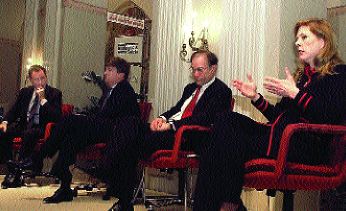
Panelists ponder a question during the recent Joint Industry Forum. From left to right: Sean F. Mooney, chief economist and research director, Guy Carpenter & Company; V.J. Dowling, managing partner and senior insurance stock analyst, Dowling & Partners, Securities L.L.C.; Michael S. Pritula, director, McKinsey & Company; and Alice D. Schroeder, managing director, Morgan Stanley.
When it comes to terrorism insurance, the song may be over, but the melody lingers on.
And on, and on, and on.
Congress may have passed the Terrorism Risk Insurance Act, but this issue is far from fading--not by a long shot--from the minds of executives and industry analysts. As surely as terrorists will strike again, the core problems will re-emerge to haunt the business when the three-year limit on the measure runs out.
This was made abundantly clear (if sheer numbers and impressive industry firepower count for anything) during this year's staging of the Joint Industry Forum. The conference brought together nine CEOs and four industry analysts, not to mention an audience of some 250 marquee names, for big-picture discussions of major insurance issues. They talked about other things, but all 13 dwelled at length on the lingering and nagging issues of terrorism and terrorism insurance.
"I think the terrorism bill represented perhaps the very best of what the industry has to offer," said moderator Edward M. Liddy, chairman, president and CEO of Allstate Insurance Company. "I think we should revel and enjoy that success. [But] be careful what you wish for because your wish may come true." The questions now, said Liddy, are: Can we live up to expectations? What does it mean for our customers and for our companies to finally have this bill passed? Will it be what we want it to be?
The panel was concerned that expectations are too high on what the legislation will accomplish, including an over-emphasis on lowering the price for terrorism coverage.
"The legislation removes the insolvency risk for companies," said Joseph P. Brandon, chairman and chief executive officer of General Re Corporation. "The industry is still early in the development stage of its ability to price this risk."
Note: The Terrorism Risk Insurance Act allows for a backstop for certain future terrorist attacks--a sharing of losses between the government and the insurance industry for a three-year period. Private insurers have maintained for over two years that without such a safeguard, they would not be able to underwrite what is essentially an uninsurable risk. Congress, on the other hand, has sought to cushion the American economy from further damage due to terrorism.
The Insurance Information Institute, one of the nine sponsors of the event, estimates that the insured loss from September 11, 2001, will be $40.2 billion. A comparable loss from a future terrorist attack would still leave the insurance industry responsible for between $11 billion and $20 billion, the Institute says.
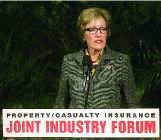 Marsha Johnson Evans, president and CEO of the American Red Cross, was one of the 250 "marquee names" who took part in discussions at the Forum.
Other sponsors of the event were the Alliance of American Insurers, the Insurance Services Office, the American Institute for CPCUs, the National Council on Compensation Insurance, the Institute for Business & Home Safety, the National Insurance Crime Bureau, ACORD and the Geneva Association.
According to Ramani Ayer, chairman and chief executive officer of The Hartford, "The cost of this coverage could remain high for some time." He added: "We can't ignore the reality that another attack may come. Even with the legislation, insurers are retaining a substantial risk which will make this an ongoing underwriting challenge. Cost will vary from business to business depending on factors such as proximity to metropolitan areas, high-profile properties and especially the workers compensation exposure that comes with the large concentration of people in one place."
"If you look at the risk, there is a false sense of predictability," added Edward B. Rust, chairman and chief executive officer of State Farm.
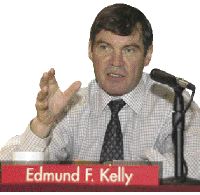 "We have to remember what we understood on September 12, 2001. This was an act of war and it is fundamentally not affordable."
--Edmund Kelly, Chairman Liberty Mutual
To which Edmund Kelly, chairman of Liberty Mutual, added:
"We have to remember what we understood on September 12, 2001. This was an act of war and it is fundamentally not affordable. It is easy to put together a $200 billion scenario ... This is something we will have to confront in three years."
The panel agreed that the war on terrorism and the threat of conflict with both North Korea and Iraq may also affect the industry's ability to improve its investment returns should the market rebound in 2003.
"War is a real unknown," said Walter Kielholz, vice chairman of Swiss Re. "It will create a great deal of uncertainty in insurer portfolios. Given current interest rates, there may be nowhere to hide."
Rust added: "I expect the market to come back slightly. However, because of the new reality that we face, a rebound could be short-lived."
Also on the panel were Brian Duperrault, chairman and CEO of ACE, Ltd.; Jeffrey H, Post, president and CEO of Fireman's Fund Insurance Companies, and James J. Schiro, CEO, Zurich Financial Services.
A second panel of industry analysts, this time moderated by Sean Mooney, of Guy Carpenter & Company, also spoke to the subject.
"We didn't think a bill was going to pass in 2002," said V.J. Dowling, of Dowling & Partners Securities in Hartford. "I still think it's up in the air how things are going to play out, e.g., what reinsurers will be able to do in terms of filling in gaps."
"One thing's clear," said Dowling. "Primary companies as a whole have more coverage than in the past in a macro environment. From a reinsurance perspective that's probably a bad thing. We don't know what the takeoff's going to be on the primary level, so we'll have to wait three or four months and see."
Added Alice Schroeder, of Morgan Stanley, "It was important to get a bill, for both primary and reinsurance companies."
The panel of analysts also did a review and outlook for 2002 and 2003.
Dowling on 2002: "Quite a good year on pricing across the board." There were 50% increases on personal lines and "dramatic improvement" on rates and loss costs, though there's much still to be done. There were, however, "positive moves on the personal side" and "on the standard commercial side, there were very, very big rate increases, in the teens and higher, even higher in specialty lines and reinsurance."
Dowling continued, "But that's not the question. We needed a much bigger bounce off the bottom, and not all lines are still at levels that will generate the types of returns that are needed. But we made an awful lot of improvement."
Faced with the same question, McKinsey & Company's Michael Pritula offered a frank, "Who the hell knows." On the personal lines side, he said, rate increases have looked favorable for the last couple of years. Still, he added, there are troublesome underlying exposures and there is, as he put it, "the continued creativity of the plaintiff's bar."
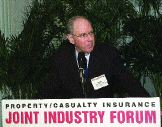 Gordon Stewart, president of the Insurance Information Institute, which was one of the nine Forum sponsors.
So what's necessary? "Tough question. It's certainly looked good on the personal lines side and we've had at least a few enlightened state houses responding to the underlying loss cost issues, but there are some states where we still don't have that enlightened stewardship," said Pritula.
"On the commercial lines side, things looked great on the surface but, again, what are the underlying exposures?" asked Pritula. "It's very difficult to tell, but I'm optimistic. Things continue to look good."
Morgan Stanley's Schroeder added: "The industry did not put up a lot of reserves through the nine months, despite increases in pricing and cash flow." Reserves, she reported, were below expectations and that, combined with depressed rates over the last three years, "suggests there's a lot more work to be done to add value."
As for 2003, Schroeder sees no "big uptick" in the light of projected flat investment for the industry. Dowling forecast a modest decline for the coming year, but she added, "This will likely be the bottom year."
According to a poll conducted by the I.I.I. during the meeting, property/casualty industry leaders expect an improvement in profitability for 2003 compared with last year. Executives are optimistic that the industry is on the road to recovery. Seventy five per cent of survey respondents expect 2003 to be more profitable than last year, as measured by the combined ratio. The combined for 2002 is estimated at 103.3. Eighty one percent thought the hardening of the commercial lines market would continue through 2003, and 92% thought the same would be true of the personal lines market. Following passage of the Terrorism Risk Insurance Act of 2002, 75% of survey respondents believe that it will be easier for businesses to obtain terrorism insurance coverage.
Robert Hartwig, chief economist of the I.I.I., noted that the hard market was already well underway before September 11 and is likely to continue into 2004. "Rates of return in the property/casualty insurance industry, while improving, are still only in the 4%-5% range, well
below the 10% to 15% typical of Fortune 500 companies." *
The author
Tom Slattery is an independent business journalist. The former executive editor and publisher of National Underwriter and former executive editor of Insurance Journal is currently managing director, Slattery-Esterkamp Communications, Baldwin, New York.
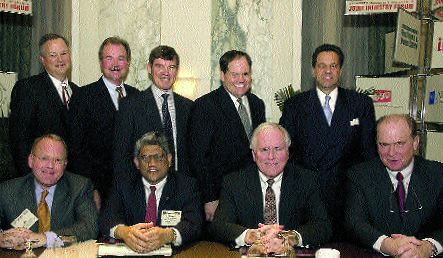
Standing from left to right: Jeffrey H. Post, president and CEO of Fireman's Fund Insurance Company; Brian Duperreault, chairman and CEO of ACE Limited; Edmund F. Kelly, chairman of Liberty Mutual; Edward B. Rust, Jr., chairman of the board and CEO, State Farm Mutual Automobile Insurance; James J. Schiro, chief executive officer of Zurich Financial Services. Seated from left to right: Joseph P. Brandon, chairman and CEO of General Re Corporation; Ramani Ayer, chairman and CEO of The Hartford; Edward M. Liddy, chairman, president and CEO of The Allstate Corporation and Allstate Insurance Company; Walter B. Kielholz, vice chairman of the board of Swiss Re.