
No need to rush in, but have a plan to
By Joseph S. Harrington, CPCU
For now, program managers can still afford to be hesitant or even skeptical about implementing artificial intelligence (AI) in their core operations, according to Paolo Cuomo, an executive director in the strategic advisory practice with Gallagher Re.
But make no mistake, he says: AI will not be like blockchain, a technology that fell short of fulfilling the hype surrounding it. Most companies can get by without using blockchain, but AI will be truly transformational, like the internet. In time, AI will be integral to virtually every operation involving any level of decision-making.
Thus, the question is how and when, not whether, managing general agents (MGAs) and other intermediaries will implement AI. Most are at least experimenting with targeted applications of it already.
In an address at the April 2026 TMPAA mid-year meeting in Dallas, Cuomo acknowledged that program managers might be detecting more promise than performance from AI to date.
“Why is it that everyone is saying the world is going to change but I’m not seeing much of it?,” he asked rhetorically. He responded later that it is “completely fine” not to be implementing AI yet in core operations—“as long as that’s not an excuse for not having a strategy for when you will engage.
“We in insurance don’t have to be in the vanguard of [AI], but we need to make sure we’re on the right train at the right time.”
Content to context
Cuomo told the gathering that AI presents the “paradox of abundant knowledge”—the circumstance where everyone not only has instant access to answers to almost any inquiry but are automatically directed to relevant information they did not know to seek, and to new lines of inquiry they hadn’t considered.
The consequence of this will be profound “value shifts” in competitive enterprises. Chief among these is a shift in value from the content of information, available to anyone instantaneously and almost entirely, to the context of information, the ability to seek, select, and apply knowledge to create value.
Among individuals, this transformation will put a new premium on certain traits and talents, especially among entry-level workers. The ability to gather and communicate information will diminish relative to the ability to apply judgment. Expertise will be defined less by the mastery of “static knowledge” and more by one’s ability to “navigate liquid knowledge.”
Job qualities
It follows that qualities once highly sought among job candidates, such as orientation to detail, will become relatively less important than their ability to “orchestrate” the use of AI and “articulate” an evolving vision of client needs and enterprise objectives.
“If you’re an English major at university, suddenly people are going to want to hire you again,” Cuomo said. “There’s a [belief] that you will do a better job engaging with AI” than a technical major.
In describing applications of AI, Gallagher Re distinguishes between “digital minions” and “digital sherpas.” The former excel at automating close-ended tasks so risk professionals can focus on customer relations and risk decisions, while the latter are designed to actively challenge underwriters, claims managers, and brokers to consider alternative approaches.
Once they’re brought onboard, new employees will find themselves very quickly “upskilled,” in Cuomo’s phrase. He explained that over time AI can “codify” the traits and practices of experienced employees into company operations, immediately transmitting their expertise into decision-making at lower levels.
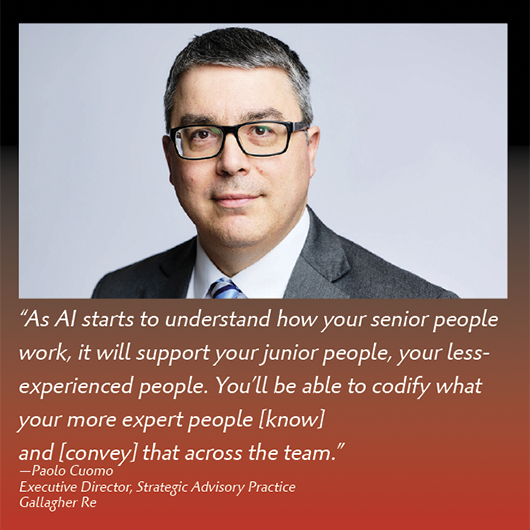
“As AI starts to understand how your senior people work, it will support your junior people, your less-experienced people,” he said. “You’ll be able to codify what your more expert people [know] and [convey] that across the team.” In turn, new employees will be put in charge of AI “much earlier than you would have put them in charge of a team of people.”
Business transformation
Given that AI relieves an organization of so many routine tasks, and makes technical capabilities commonly available to all competitors, Cuomo stresses that sound implementation of AI must be driven by business considerations and not constrained by legacy technology.
“This is a business discussion, not an IT discussion,” he said, adding that the only limitation a program manager should face in applying AI would be its own imagination. “The limit is your ability to do the change management, to train your staff, to engage your people, to identify where the opportunities are.”
When considering how to evaluate the return on investment in AI implementation, Cuomo identifies three key focal points:
- “Operational Alpha” looks at AI’s impact on expense ratios by reducing or eliminating routine tasks and freeing up staff for more value-added activities.
- “Capacity Confidence” looks at how AI strengthens an intermediary’s alignment with carrier objectives and operations by sharing information seamlessly.
- “Product Agility” looks at how AI enhances an intermediary’s ability to differentiate itself from competitors by identifying and exploiting market opportunities.
All of these factors feed into the single biggest consideration, says Cuomo: customer satisfaction.
The author
Joseph S. Harrington, CPCU, is an independent business writer specializing in property and casualty insurance coverages and operations. For 21 years, Joe was the communications director for the American Association of Insurance Services (AAIS), a P&C advisory organization. Prior to that, Joe worked in journalism and as a reporter and editor in financial services.