Tech firm provides software to
prevent mobile device use while operating vehicles
By Christopher W. Cook
More than 20 years ago, after a late night with friends, this writer hit a mailbox with his car, cracking the windshield and destroying a side mirror. I had been distracted, not by a cellular phone (I’m pretty sure I had a Samsung flip phone at the time) but rather because I was messing with the controls on my vehicle’s cassette deck. Man, I feel old now.
April is Distracted Driving Awareness Month, and while cassettes are a thing of the past (even though I still have a box of old mixtapes in my basement), the cell phone is a key contributor when it comes to causing vehicular distractions.
According to SambaSafety’s 2024 Driver Risk Report, 84% of 30- to 44-year-olds said they had used an app while driving within the past month; 31% of employees admitted that their distracted driving had caused an accident, an increase from 26% in 2022. Distracted driving reportedly is responsible for $385 billion in damages a year, and 2022 saw around 3,300 people lose their lives to the dangerous epidemic.
Some 30-plus states prohibit drivers from using a hand-held cellular device while operating a vehicle, but it still occurs and fatal accidents still happen. This is where technology comes into play.
Over 10 years ago, LifeSaver Mobile was founded in Silicon Valley, California, by Ted Chen, who serves as CEO, and Mike Demele, the company’s CTO. Joel Gattoni is the firm’s director of sales.
What started as a customer solution during its first few years shifted to a business-to-business model, primarily in the field of commercial fleets. “We spent a year or two on the consumer side and then realized that it was not a proper or viable business model,” Chen says. “The rest of the time has been spent in B2B.
“The platform has grown tremendously,” he adds. “We’ve supported well into the six-figure range of number of drivers and, at last count, we have over 2 billion miles of driving data in our platform since we started.”
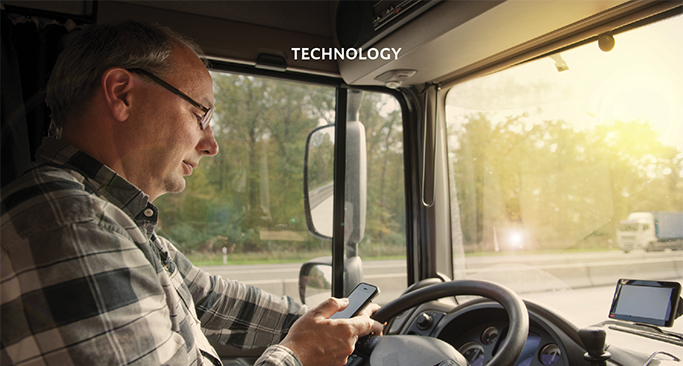
In a nutshell, LifeSaver Mobile’s software detects when employees are operating a vehicle and disallows the use of their mobile device. “[People] are addicted to the constant pings and notifications and endless scrolling [on cell phones]. These things were designed to be addictive,” Chen says. “They’re amazing devices, but they become hugely problematic and deadly when it comes to operating a vehicle, especially an 80,000-pound long-haul truck.
“We operate primarily on work-issued mobile devices—phones and tablets—because it’s super hard to get an employee to put this on their personal phone,” Chen continues. “People want to multi-task as much as possible on every device that they have in order to get their work done faster, so work devices are equally distracting as personal ones.
“And if you don’t secure that work device, you’re asking for trouble,” he notes, “because you own it and have every right to control it. If you don’t, guess who’s going to find out [when there’s an accident]? The plaintiff’s attorney. Then you’re in big trouble.”
Installation can be executed with either mobile device management (MDM) software or, if personal phones are used by the employees for work purposes, deployment can be done through SMS notifications triggered through the company’s LifeSaver administrative portal.
“Everything happens in a portal,” Chen says. “You invite your list of drivers, and they will each get a text message asking them to deploy the app via a link. Once installed and they accept permissions, they sign in for the first time and they’re online and in good standing with the program. You’ll get daily reports of who’s not active or online, so you have a way to account for whether people are using it.”

“[Cell phones are] amazing devices, but they become hugely problematic and deadly when it comes to operating a vehicle, especially an 80,000-pound long-haul truck.”
—Ted Chen
Co-Founder and Chief Executive Officer
LifeSaver Mobile
Other features include the enforcement of hands-free calling (or no calling), voice alerts for speeding, and the use of voice alerts for other time-sensitive information that the driver needs to know safely but quickly so they can react accordingly.
“There are so many different use cases where a company wants to tell their drivers in real time something they need to know that’s critical business information like ‘you should pull over because the customer cancelled,’ or ‘I want you to reroute,’ or ‘there’s a low-clearance bridge coming up.’ How do you let your driver know without their looking at a device and being distracted? The answer is voice,” Chen says.
“With voice, there’s the power of real time and safety,” he explains. “Our app can be the voice of those alerts, which can be customized by the employer. You can say, ‘I want this message to go out for rerouting,’ or ‘I want this message to go out for a roadside vehicle warning.’ All these [alerts] can be customized so that they don’t become just an ambiguous beep.”
Voice alerts can be programmatic, so if multiple vehicles on a specific road need to be rerouted, one message can reach each one.
Like several companies in this “AI age,” LifeSaver Mobile is also working on utilizing artificial intelligence on its platform, including aiding with identifying drivers who are more likely to get into accidents. Chen notes that the data from the new feature will quantify a fleet’s drivers by skill level, which will help from an underwriting perspective. AI is also being planned to force compliance on the platform for drivers who willingly decide to shut it off.
“Those are some of the big use cases around AI that we see are valuable to help our business and help our customers,” he says.
While in-cab technology solutions for commercial auto have been around for a while, Chen finds his software unique compared to others.
“The [solution] that’s been around the longest is telematics, that base layer of knowledge—driver behavior and location tracking. Most people have it,” he says. “But it really doesn’t do anything for phone distraction, so we partner with a lot of telematics [firms], because they see that our value prop is very incremental to what they do.
“And then we have the video side—dashcams. Some companies can’t overcome the costs because dashcams aren’t cheap.” Companies that do purchase dashcams also have to worry about privacy issues, so they might have just the forward-facing cameras, Chen notes.
A dual-facing camera can be valuable if the company can overcome the privacy challenges, but, Chen asks, “Does it solve the problem of phone distraction? No. It gives you the recognition and awareness of how often the phone is being handled because now you’re seeing it on video. You have irrefutable evidence that phone distraction is occurring, and this is how much it is occurring.
“If every insurance company in North America believes that [distracted driving] is the number one cause of crash frequency, the fastest way to lower your claims and your potential liability associated with those claims is to solve the phone problem. I think every insurance company in North America will agree with that.”
LifeSaver Mobile is finding success from clients who take the steps to tackle the phone issue. In a case study, one client, K&B Transportation, an 800-truck fleet that specializes in delivering refrigerated perishable products, located in South Sioux City, Nebraska, has experienced a 67% reduction in crash frequency over the three-year period since partnering with LifeSaver Mobile in 2022.
Director of Safety Lance Evans noted in the study that like other trucking companies, K&B faced rising premiums and discovered that “traditional hardware-based solutions are costly and invasive.” He valued the privacy-conscious product offering from LifeSaver Mobile that takes a proactive approach to modifying driver behavior without the use of video monitoring.
Ultimately, the decrease in crashes led to the trucking firm’s being able to switch to a self-insured model. “This is what every fleet operator in North America and arguably around the world wants—to control their insurance destiny. Because right now, it’s out of control. You can’t do anything to bring down costs because the rest of your peers are not cooperating from a claims perspective,” Chen says. “We’re seeing a lot of traction from the carrier and captive communities. Carriers know us.”
With its “download and use” software model, Chen considers his product offering to be “an ‘easy button’ for claims reduction, and there’s no coaching required. For phone distraction, telematics doesn’t do anything. For cameras and in-cab alerts, coaching is required. That’s a key thing that insurance providers are realizing, [with LifeSaver Mobile] you can [download it], subsidize it, require it, and this could be the path to improving your book of business and loss ratio,” he concludes.
While the company primarily addresses the pain points of road safety in the commercial transportation industry, the firm has also been developing partnerships to resolve device distraction issues for warehouses (forklift operators), tarmac operations (luggage tuggers) and rail companies, among others, because employees can be addicted to their cell phones anywhere.
Speaking of addiction, on its website, you can also download LifeSaver Mobile’s eBook The Science Behind Cell Phone Addiction.
Now, put the phone down, and eyes on the road.
For more information:
LifeSaver Mobile
lifesavermobile.com