Legacies of past abuse
haunt today’s risk management
By Joseph S. Harrington, CPCU
A year ago, the online magazine Blue Avocado, a publication and portal aimed at leaders of nonprofit and social service organizations, asked: “Why Are Nonprofits Experiencing an Insurance Crisis?”
The problem wasn’t any change in risk for the sector, the article stated, but rather the result of “opportunistic attorneys, social and financial inflation, climate change, limited options for reinsurance, and legacy claims from the COVID-19 era.”
“Going forward,” the article adds, “it will be increasingly difficult for nonprofits to secure the insurance they need to keep their doors open.”
A year on, things don’t look quite so dire. Today, it would be a stretch to call the situation a “crisis” that imperils the ability of nonprofits “to keep their doors open.” When challenges persist, people adapt, and nonprofits and their insurance agents and brokers are adapting to challenges that are clearly not going away any time soon.
Liability woes
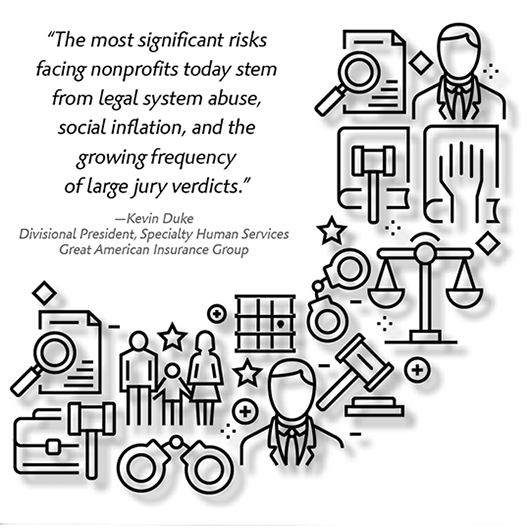
“The most significant risks facing nonprofits today stem from legal system abuse, social inflation, and the growing frequency of large jury verdicts,” says Kevin Duke, divisional president for Great American Insurance Group’s Specialty Human Services.
With an added boost from third-party litigation financing, he finds that “a well‑funded plaintiff’s bar is redirecting scarce resources away from mission delivery, reducing the funds available to support the communities these organizations serve.”
Compounding the risks social services and nonprofits face today are so-called “tort reforms” to extend or eradicate statutes of limitations for sexual and physical abuse cases, says Joe Carlson, executive vice president for healthcare, human services, and life sciences at Amwins, a global specialty insurance distributor.
“These ‘reviver’ statutes bring back incidents from many years ago,” Carlson says. “Incidents of abuse often occurred before a previous statute of limitations trigger date and can result in unpredictable claims stemming from many years ago. In the past, these same claims would have been dismissed or thrown out.”
Along the same line, Duke finds that “long‑tail exposures like abuse and auto liability are developing over extended periods, contributing to higher loss severity and increasing settlement costs for carriers.”
Retentions and restrictions
These trends aren’t new, but they have continued unabated as nonprofits have also grappled in recent years with substantially growing costs for property risk, not something that’s traditionally been a major concern for nonprofits.
Today, Duke finds “some signs of stabilization” in property insurance while casualty lines continue to face pressure. “The market for casualty coverage, including primary umbrella and excess layers, continues to be challenging and remains firmly disciplined,” he says.
“Carriers are adjusting limits, deductibles, and participation by state or class to manage exposure in challenging legal environments,” Duke adds. “From a coverage standpoint, carriers are being more precise in policy definitions, exclusions, and deductible structures.
“Excess placements remain especially difficult,” he continues. “There’s limited availability of excess limits above $5 million, and surplus or Lloyd’s markets often prove to be cost‑prohibitive, particularly for abuse‑exposed risks.”
Regarding liability coverage, Carlson says that Amwins is seeing higher retentions demanded by carriers, up to $100,000 for “tougher” risks.
“We are also seeing a number of coverage limitations,” he says. “These include restrictions for self-inflicted client injury, physical abuse of clients, client elopement, bathroom hazards, and failure to conduct criminal and sexual abuse background checks.
“They also include coverage restrictions on risks associated with client transport and habitation, many times excluding client transportation and reducing habitability claim sublimits as they are major loss-drivers.”
Market softening?
Despite continuing pressure in liability risk, the overall market for nonprofit property and liability insurance may be softening, or at least not getting appreciably harder.
Capacity remains “constrained,” according to Duke, but “most of the significant reductions have already occurred.”
For their part, Duke sees buyers focusing on securing the protection they need, opting to retain more risk through higher property deductibles and higher deductibles and/or self-insured retentions for liability coverage.
“This approach drives stronger engagement in risk management,” he says. “At the same time, it helps insureds afford higher excess limits that are often only available in non‑admitted markets.”
Dave Lehman, senior commercial underwriter for Roush Insurance Services, Inc., an Indiana-based wholesaler, says that “the overall P&C market is starting to soften, and that includes the market for nonprofit and social service risks.”
Regarding property coverage, Lehman observes that Roush is seeing increases in the total insured values its markets are willing to offer, along with reductions in property rates for many classes of business, including nonprofits and social services.
“On the property side we haven’t seen any changes in deductibles or limits with our excess and surplus lines (E&S) carriers,” he says. “Our E&S carriers have always been a good fit for nonprofit and social service accounts when standard markets are not interested or are pulling back.”
E&S to the rescue?
Indeed, as they have in other classes of commercial insurance, E&S insurers are being tapped to fulfill demand left as admitted carriers retrench.
“More insurers are taking a chance on these nonprofit risks,” says Carlson. “Some carriers may not have written coverage for them before. Given the vulnerable populations they serve, these risks often have heavy claim activity, so we are seeing cautious underwriting and lower limits being deployed.”
According to Carlson, package writers earlier would commonly provide a primary $1 million occurrence limit with a $3 million aggregate limit, and a $5 million umbrella over that. Now, he sees carriers limiting excess umbrella coverage to $2 million or less.
For accounts that can’t sustain such reductions in coverage, E&S markets provide the limits and specialized coverage forms they need, Carlson says. “When standard markets can’t support them, E&S markets are there with capacity and risk management services, which are extremely vital in this sector.”

Artificial intelligence
No area of commerce or risk will be immune from the effects of artificial intelligence (AI), which is spreading rapidly through every sector of society.
According to Carlson, Amwins’ nonprofit and social service clients are adopting AI to allocate and manage resources, manage privacy and data security, and to monitor staff credentialing and compliance.
In a strategic sense, “AI is helping organizations predict how demand for services will be affected by socio-economic conditions,” he says. “It’s also helping them identify key risks and barriers to entry when deciding whether to enter new areas of service work—something social service organizations do regularly to expand their operational outreach.”
AI also carries risks.
“Artificial intelligence may amplify existing cyber and privacy risks by inadvertently exposing sensitive information,” says Duke. In the area of professional and management liability, he finds most nonprofits are using AI “as a support tool rather than a decision-making tool,” maintaining human accountability under an organization’s leaders.
“Advances in AI are just beginning to influence social service operations,” he says. “The same is true for insurer underwriting and account review. The full impact is still taking shape.”
For more information:
Amwins
amwins.com
Great American Insurance Group
greatamericaninsurancegroup.com
Roush Insurance Services
roushins.com
The author
Joseph S. Harrington, CPCU, is an independent business writer specializing in property and casualty insurance coverages and operations. For 21 years, Joe was the communications director for the American Association of Insurance Services (AAIS), a P&C advisory organization. Prior to that, Joe worked in journalism and as a reporter and editor in financial services.