
Brown & Brown’s rebranded specialty
distribution segment leverages decades of experience
By Maura C. Ciccarelli
When crises like natural disasters or nuclear verdicts impact the general industry’s ability to respond to customer needs, carefully underwritten and designed specialty and niche programs can fill the void.
What began as Brown & Brown’s wholesale and MGU/MGA business segments has evolved into Arrowhead Intermediaries, now made up of a portfolio that placed more than $20 billion in premium in 2025. As these specialty distribution businesses have reorganized, leadership has kept a close watch on what’s happening—and where. That’s fueled their ability to provide programs, wholesale, and specialty solutions for agents and brokers in the United States, Canada and abroad.
“We don’t want an agent or a distribution partner to have to tell their customer, ‘I don’t have a solution to that problem,’” explains Arrowhead Intermediaries Chairman Chris Walker. “We want to be the ones that have a solution for those unique niche-y situations where they need a high degree of specialization.
“The keys for us have been to listen to the agents, put ourselves in their shoes, and then build strong, long-lasting, stable relationships with carrier partners,” he adds, noting that Arrowhead Intermediaries’ more than 7,900-person organization represents a lot of talent addressing market gaps.
“By the mid to late ’90s and beyond, our programs business really started to change its focus to be a specialty MGA introducing solutions that addressed market dislocations,” explains CEO Steve Boyd.
For example, in the 1980s, it was offering non-standard auto. When carriers left the California market after the 1994 Northridge earthquake in Los Angeles, Arrowhead launched a homeowners product in the state. The result was a market-leading presence for the company. Arrowhead grew one of the largest portfolios of residential earthquake coverage in California.
It also launched a specialty workers comp product when the California market experienced turbulation in the early 2000s. Experiences like those spearheaded innovation for the company.
“We continued the rollout of new products and technologies—agent-facing solutions to make it easier for them to do business,” Boyd says.
Arrowhead Intermediaries’
ecosystem
Arrowhead General Insurance Agency joined brokerage Brown & Brown in 2012. Last year, Brown & Brown acquired Accession Risk Management Group, including its wholesale and program manager operations known as One80 Intermediaries. Then, Brown & Brown combined its legacy wholesale, program and specialty operations with the One80 businesses under the new Arrowhead Intermediaries banner. The three operating divisions are:
- Arrowhead Programs, which offers specialized insurance solutions in the United States and abroad. Its managing general agents (MGAs) and managing general underwriters (MGUs) work with top-rated insurance companies to deliver a diverse suite of niche offerings designed to meet the specialized needs of policyholders.
- Bridge Specialty Group, the global wholesale arm, with locations in the United States, United Kingdom, United Arab Emirates and Asia. Teams of seasoned industry professionals provide a wide range of creative solutions to meet the needs of retail brokers, including access to admitted, excess and surplus lines providers, as well as Lloyd’s markets.
- Arrowhead Specialty, which was formed when One80 Intermediaries joined last year and provides highly tailored solutions that address complex and evolving needs, including captives, life and health, travel/accident and health, reinsurance, affinity business and warranty coverage.
“Now we are bringing this together [to] simplify that experience and value proposition,” Boyd notes, adding that the organization is designed to help agents and brokers face both familiar and emerging market challenges.
Today, for example, getting homeowners insurance in California feels like it did in the 1990s, Walker says. As a result, Arrowhead again developed a new product for homeowners in California.

“The keys for us have been to listen to the agents, put ourselves in their shoes, and then build strong, long-lasting, stable relationships with carrier partners.”
—Chris Walker
Chairman
Arrowhead Intermediaries
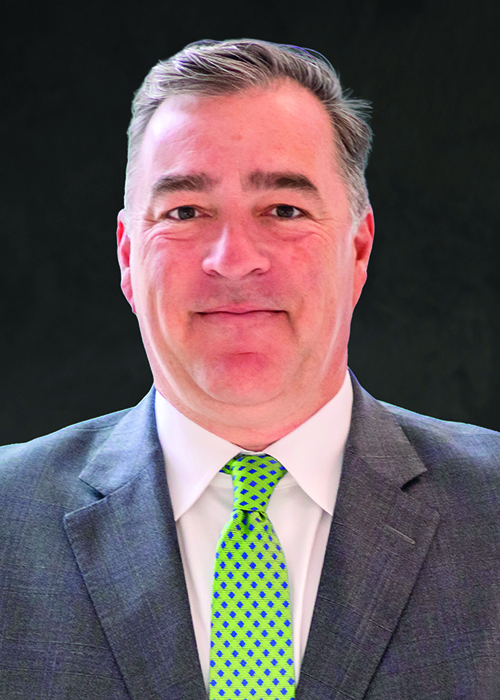
“When a retailer comes to us, we want to educate them and get them prepared to deliver a solution to their customer, understand all aspects of what they’re getting, what they are not, and how they deal with that space.”
—Steve Boyd
Chief Executive Officer
Arrowhead Intermediaries
AI is naturally bringing new challenges that impact potential claims around product liability, cyber risk and more.
E&S, which accounts for 24% of the industry’s GWP, is emerging as a popular solution when there are coverage voids. “There’s unlikely to be a massive shift backwards,” Boyd says.
Today, the company’s $20 billion in placed premium is split between admitted and non-admitted, Walker notes. “We are able to place a lot of business that others would look at and say, ‘Wow, that can be tough stuff.’
“We’re bringing solutions to some pretty challenging markets with strong, name-brand carrier partners,” Walker adds. “Our carrier partners have done really well in our portfolio because we’re pretty good underwriters, too. We’re trying to bring strategic and creative solutions for the agents.”
“Each of our programs, including within our wholesale business, is focused on a specific segment and is a specialist in that space,” adds Boyd. “When a retailer comes to us, we want to educate them and get them prepared to deliver a solution to their customer, understand all aspects of what they’re getting, what they are not, and how they deal with that space.”
Balancing tech and relationships
The use of tech—AI in particular—has completely transformed how agents and brokers can become specialists. It also has changed how Arrowhead Intermediaries’ niche-focused underwriters can identify a good risk in a tough sector that many other people wouldn’t even offer a quote for, Boyd explains.
Still, Arrowhead Intermediaries wants to meet its retail partners “where they want to be met,” he says. “We’ve got numerous products that you can quote, buy, and service online. Ease of doing business has been front and center [for Arrowhead] for decades.”
But, he notes, insurance is still ultimately a relationship-based business where people need to work together.
“Sometimes the problems are really complex, and it’s not as simple as getting an instant quote from an AI agent,” Boyd explains. “AI becomes a really helpful assistant for our underwriters and for our brokers on the wholesale side who are trading with the retailer. It can help us get information quicker, more accurately … but I don’t see it replacing those aspects of the relationship by any means.”
AI can also have positive and negative effects on how agencies do business, he adds. It can allow agents to get into new sectors, develop a new niche expertise, and build out the knowledge set.
“At the same time, you have to defend your castle, and so if [a niche area is] something that you’re really good at, [AI] has lowered the barrier to entry, potentially, for others to get in and compete with you.”
Walker also notes that there’s a developing challenge of online-based insurance tech start-ups. When it comes to E&S or other market solutions, agents have to carefully vet whether the operation has the expertise, market availability and financial stability to take on the risks.
“It’s a big selection process,” he says. “If you think about how fast the market moves, that’s a challenge for agents.”
Arrowhead Intermediaries is working with strategic global technology partners to keep a careful focus on strong governance for its internal use of AI, says Boyd, who did a stint as senior vice president of technology, innovation, and digital strategy for Brown & Brown.
“We don’t believe in top-down AI mandates. We want bottom-up use cases from the business,” he states. “AI can help actuarial work, software development, rate changes; compress time to market; [and] help people in their daily jobs. But anything agent-facing is something we’ll put a lot of testing and review into before leaning into it.”
Agent/broker keys to success
Having watched the specialty and niche program markets for decades now, Arrowhead Intermediaries’ two leaders note that agencies and brokers will need to sharpen certain skills going forward in this changing industry.
Boyd, who started at Arrowhead General Insurance Agency in 1995, emphasizes that for agencies and brokers, catalysts for growth include having the right culture, navigating talent wars, establishing a perpetuation strategy, getting a good handle on the E&S trend and maximizing the use of data—particularly by using AI—to drive profitability.
Walker, who came to Arrowhead General Insurance Agency in 2003, adds that challenges for agents include keeping up with regulatory changes, market knowledge and knowing “who’s buying who” and what it means for a book of business.
Agents and brokers have more choices about whom they can work with, Boyd emphasizes, so it’s more important than ever before to “make sure you’re partnered with the right people.”
For more information:
Arrowhead Intermediaries
arrowheadintermediaries.com
The author
Maura C. Ciccarelli is a longtime freelance journalist originally from Philadelphia. She writes about business and more from an adobe home in southern New Mexico, after spending nine years living on the road fulltime with her husband in their Airstream trailer.