How today’s advisors use prevention,
data, and operational insight to win and keep better accounts
By Randy Boss, CRM, CIC, MWCA
For many years, risk management was something that sat in a binder. The safety manual was just another book on the shelf. A checklist might be reviewed quickly before renewal time. Discussions about risk usually happened only after someone was injured.
I was recently sitting with the owner of a construction company, reviewing his renewal, when he said something that I hear surprisingly often: “Our experience mod is killing us. What do we need to do to fix it?”
It’s a common question, and it points to a common misunderstanding.
After more than four decades working with employers on workers compensation performance, I’ve learned something important: The experience mod isn’t really an insurance problem. It’s an operational one.
Companies that treat risk management as nothing more than paperwork often face rising costs and unpredictable renewals. Those that integrate it into daily operations usually see more stable premiums, better relationships with underwriters, and a stronger competitive position.
The agencies that win and keep the best accounts do more than just market insurance programs. They position themselves as partners in operational performance.
Risk management is no longer just a department. It’s a strategy. This shift requires agents to rethink how we advise clients and how we approach risk management in today’s business environment.
The shift: From insurance buyer to risk operator
For many years, the traditional advisory model was largely reactive:
- Quote, bind, service
- Respond to claims
- Shop the market at renewal
- Hope the cycle cooperates
That approach worked when the market was soft, but it falls short when discipline is required.
Today, the most effective advisors take a different approach. They help clients shift from simply buying insurance to becoming risk operators, organizations that understand, measure, and manage loss performance as a core business discipline.
One of the clearest signals of operational risk performance is the experience modification factor. Too often, the experience mod is treated as a yearly scorecard. In reality, it reflects how well a company manages injuries, claims, and return-to-work efforts throughout the year.
When advisors help clients understand that connection, the conversation shifts from insurance pricing to operational performance.
In my experience, the greatest leverage point in most organizations is not the safety manual or the insurance policy. It is the front-line supervisor making decisions in real time. Supervisors influence how injuries are reported, how quickly employees return to work, and whether small problems turn into large claims. When supervisors are involved and have the support they need, claim outcomes improve. Without that engagement, even the best-written safety programs often fail to deliver results.
To see steady improvement in workers compensation programs, organizations need to focus on four key principles for effective risk management:
- Visibility
- Accountability
- Measurable action
- Financial translation
Together, these principles help move risk management from paperwork to performance.
Pillar one: Visibility
You cannot improve what you cannot see.
Many organizations still view risk data as historical reporting, rather than as information that can influence operations and performance. A good advisor helps bring clarity to important metrics like these:
- Experience mod trending, not just the current mod
- Frequency versus severity patterns
- Average claim duration
- Open reserve movement
- OSHA log accuracy and incident trends
A single experience mod number only tells you where a company has been. Looking at trends shows you where it is headed.
When producers come to renewal meetings with this kind of insight, they move from being just brokers to becoming true strategists.
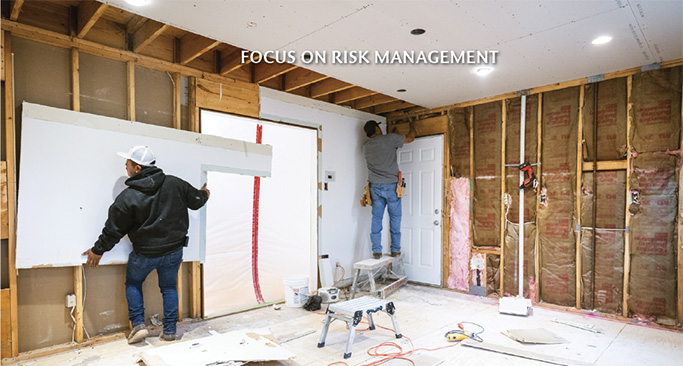
Case study: Stabilizing a contractor’s experience mod. I worked with a drywall contractor facing a challenge that many construction firms know well. Their experience modification factor had reached 1.45, hurting both their bid-winning ability and profitability. In this industry, a higher mod directly raises insurance costs and can make it harder to compete.
When we reviewed the company’s loss history, it became clear the issue wasn’t claim frequency. It was claim severity. Multiple injuries, mainly to backs, shoulders, and knees, led to unnecessarily large claims. The injuries were legitimate, but the lack of an early structured injury response process led the claims to escalate.
The company president explained it simply: “When someone got hurt, we didn’t really have a system. We just turned the claim over and hoped it worked out.”
The first step was conducting a detailed experience mod analysis. During that review, we discovered a $27,000 claim reserve that ultimately closed with no payout. Because the reserve had been included in the experience rating calculation, the company had effectively been overcharged by approximately $7,200 in premiums.
But the bigger opportunity was to improve how injuries would be managed going forward.
We worked with leadership to launch a process for rapid injury reporting, supervisor engagement, and transitional work assignments. Within the following year, two potential injury claims were identified. Early intervention and modified duty prevented escalation, resolving both cases.
Previously, similar claims averaged $20,000 each. The company avoided about $40,000 in direct costs and likely reduced its experience mod impact by over $100,000 in later cycles.
Companies that treat risk management as nothing
more than paperwork often face rising costs and unpredictable renewals.
Pillar two: Accountability
Risk management does not work when it is optional.
Safety committees that meet only now and then, light-duty programs that exist only on paper, and supervisor training that is encouraged but not tracked are all too common. These gaps can be costly.
The difference between having a program and having a practice comes down to ownership.
High-performing organizations typically have:
- A clearly designated internal risk champion
- Documented safety meeting cadence
- Supervisor accountability for incident response
- A defined return-to-work process
Agents can help guide clients in all these areas by sharing best practices, processes, and even full incident response and return-to-work programs.
Pillar three: Measurable action
Doing something is not the same as making an impact.
“We conducted training” is an activity. “Lost-time claims decreased 28% over 18 months” is an impact. A good risk advisor helps clients connect what they do operationally to the results they see. That means looking beyond whether a program exists and asking whether it is actually changing outcomes.
For example, are supervisors reporting injuries quickly? Are employees returning to modified duty sooner? Are repeat incidents declining? These are the indicators that tell you whether risk management is truly working. When organizations begin measuring the results of their actions, small improvements start to compound. Claim duration shortens. Frequency declines. Return-to-work participation improves.
Over time, those operational improvements show up where it matters most—in lower claim costs, more stable premiums, and a stronger experience mod trajectory. That is when risk management shifts from activity to real performance improvement.
Pillar four: Financial translation
If you improve risk but do not connect it to financial results, it is just safety.
When you tie risk improvement to financial results, it becomes a business advantage.
Many organizations treat safety programs as a compliance requirement or a cost of doing business. But when advisors translate operational improvements into financial outcomes, the conversation changes. When CFOs and owners see how operational decisions influence the trajectory of their experience mod and overall cost of risk, safety initiatives stop being viewed as expenses. They begin to see the connection between fewer injuries, lower claim costs, and long-term financial stability.
A well-managed return-to-work program, faster injury reporting, or improved supervisor engagement may not seem dramatic on their own. But over time those changes influence claim severity, stabilize the experience mod, and reduce the volatility of insurance costs. That is when safety programs become true investments—programs that generate measurable financial returns while strengthening the long-term health of the business.
The advisor opportunity
The best producers do more than transfer risk. They help their clients reduce risk. Producers who use this performance-based approach often see better client retention, stronger relationships with carriers, and a more resilient book of business.
Workers compensation often provides the clearest window into how well an organization manages risk operationally.
But the lesson extends far beyond one line of coverage. Agencies that make risk management a proactive business discipline consistently outperform those that take a purely transactional approach.
The author
Randall Boss, CRM, CIC, MWCA, is a Certified Risk Manager and insurance advisor at HIGHSTREET Ottawa Kent with more than 40 years of experience helping employers improve their cost of risk through prevention and operational discipline. He is also co-founder of Emerge Apps (emergeapps.com), developers of software tools designed to help insurance advisors move beyond quoting to become true risk advisors.