A stable market with robust capacity
By Joseph S. Harrington, CPCU
Good news! Maybe. The market for professional liability (PL) and “errors and omissions” (E&O) insurance remains generally soft and competitive, with plenty of capacity to meet demands for higher limits.
Is it too much of a good thing? Some observers suggest it might be.
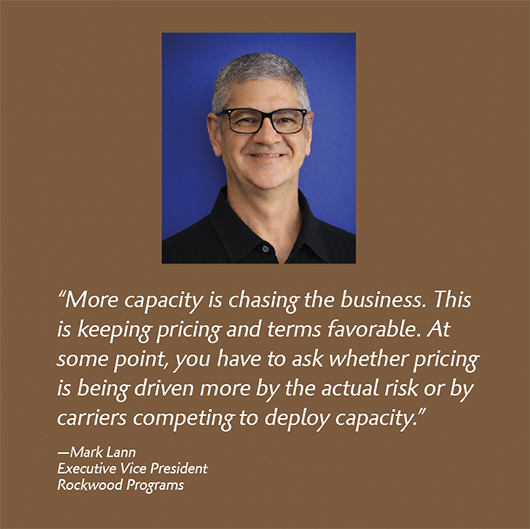
Mark Lann, executive vice president of Rockwood Programs, says that “underlying E&O exposures haven’t necessarily improved.
“More capacity is chasing the business,” he adds. “This is keeping pricing and terms favorable. At some point, you have to ask whether pricing is being driven more by the actual risk or by carriers competing to deploy capacity.”
Now is no time for professional liability insurers to relax underwriting discipline, says Nir Gabay, vice president of professional liability underwriting at Admiral Insurance Group.
“A big concern to us is that some carriers are reducing the amount of information they require to quote and bind business,” he says. “That means less underwriting information is going into pricing decisions at exactly the point in the market cycle when discipline matters most.
“History tells us that rapid growth without sufficiently seasoned loss experience can eventually lead to repricing, capacity changes, or market exits. That’s a dynamic we’re watching for closely.”
For now, however, market conditions for most professions are about as good as one could hope for.
Highly competitive
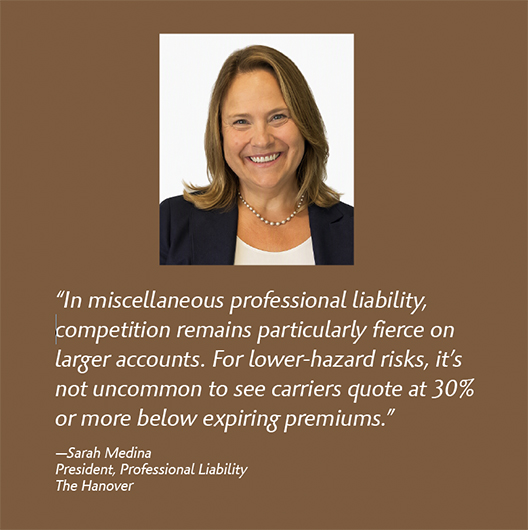
“The professional liability market remains highly competitive, with few signs of broad-based hardening across most classes,” says Sarah Medina, president of professional liability at The Hanover. “While a handful of carriers have exited specific segments or reduced capacity, we have yet to see broader evidence of capacity tightening, and several key markets continue to show little appetite for meaningful rate increases.
“In miscellaneous professional liability, competition remains particularly fierce on larger accounts,” she adds. “For lower-hazard risks, it’s not uncommon to see carriers quote at 30% or more below expiring premiums.”
Even the market for excess liability coverage, “remains extremely competitive,” in Medina’s words. “Many agents and brokers report little difficulty placing excess coverage, regardless of the line of business.
“Underwriters are well aware that they are in an increasingly competitive environment.”
Agent and broker E&O
If and when there’s a shift in the market for E&O coverage, insurance agents and brokers will likely feel it first.
Up until now, the market for insurance agent E&O insurance has never been so good, says Lann.
“I’ve been placing agents E&O for more than 30 years, and I don’t remember seeing this much capacity,” he says. “A few years ago, you questioned whether there was enough capacity to write a difficult account. Today, even large, complex, and historically hard-to-place agencies can generate meaningful competition.”
Gabay agrees that “a year ago, competition in that segment felt almost unlimited, with significant capacity and underwriting appetites.” Today, however, he finds that “some legacy carriers are beginning to pull back.
“We’re seeing rate increases from established markets and more cautious, selective underwriting from others,” he says. “It’s not a hard market yet, but the era of seemingly unlimited competition for insurance agents’ E&O appears to be ending.”
In addition, insurance defense firms are among the few classes experiencing reduced capacity in the otherwise highly competitive
Architects and engineers
Architects and engineers (A&E) are finding rates for coverage to be generally flat and even falling for design firms with good loss experience and loss control, according to Ames & Gough, a specialty brokerage that provides coverage for architects, engineers, and several other classes of professionals.
“The professional liability market remains very stable,” says Brett Gough, chief operating officer for Ames & Gough. “We really haven’t seen much hardening in the lines or classes of business we write.”
For now at least, Gough finds the market able to accommodate clients’ demands for higher limits, a function of the growing cost and complexity of projects and demanding risk transfer provisions in project contracts. At the same time, Gough sees little indication of reductions in coverage. “Most professional liability insurers continue to offer very broad professional liability policy forms,” he says. “There are also a few that have updated and enhanced their forms.
“Professional liability carriers want to see deductibles and self-insured retentions commensurate to the firm’s revenues,” Gough adds. “That can certainly be challenging as A&E firms continue to grow.”
Healthcare sector
Conditions appear to be much the same for healthcare professionals.
“Capacity in the allied healthcare professional liability market continues to grow,” says Chris Sondej, second vice president and director of Allied Health Production for Gateway Specialty Insurance. “Existing markets are eager to write more business, and several new carriers have entered the space in search of growth.”
“In healthcare, the market remains aggressive,” says Gabay. “We’re seeing traditional medical malpractice carriers lower their pricing and minimum premiums.”
He adds that some healthcare insureds are seeking to broaden their coverage.
“We’re fielding a higher volume of requests to broaden coverage,” Gabay says. “A common example is requests for prior-acts coverage on limits they have never previously purchased. Most markets follow their traditional underwriting and hold the line, but we are seeing a handful of carriers grant broader terms in order to win an account.”
Gabay sees some potential clouds on the horizon, however. “We’re seeing evolving privacy exposures, most notably claims tied to online tracking, creating real uncertainty for many consumer-facing businesses, healthcare in particular.”

Technology and AI
It’s a reflection of the underwriting capacity in PL insurance that Gabay is able to describe the market for technology E&O coverage as “fluid.” Without that robust capacity, “unpredictable” would be a better descriptor, especially in light of the potential for rapid transformation of exposure posed by the proliferation
of artificial intelligence (AI).
Gabay emphasizes that AI is a tool that supports but does not replace professional judgement and its attendant liability. In healthcare, “physicians still have to evaluate information presented to them, make clinical decisions, and meet standards of care,” he says. “AI may change how quickly information is gathered and analyzed, but it does not eliminate the professional’s responsibility for the ultimate decision.”
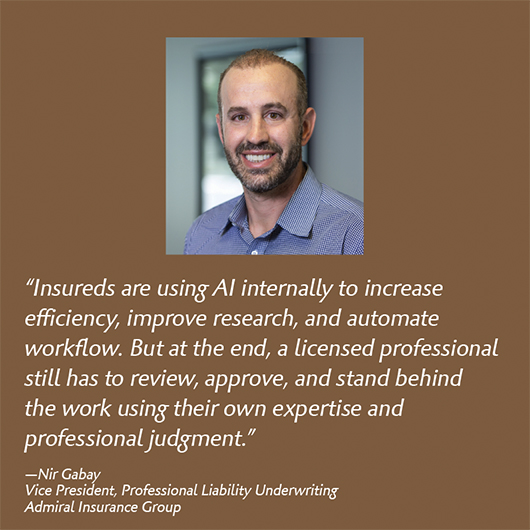
The same is true for all professions, Gabay adds. “Insureds are using AI internally to increase efficiency, improve research, and automate workflow. But at the end, a licensed professional still has to review, approve, and stand behind the work using their own expertise and professional judgment.
“We continue to view professional accountability as the central underwriting issue rather than treating the use of AI itself as a separate category of liability.”
Sondej is optimistic about the prospects for AI in healthcare. “AI has the potential to play a large part in the future of allied healthcare,” he says. We’ve seen our insureds using it to improve documentation and achieve better health outcomes through data driven insights.”
Human element
The use of AI in building engineering and architecture is not much different from earlier applications of “computer-aided design” (CAD) and “building information modeling” (BIM), says Gough.
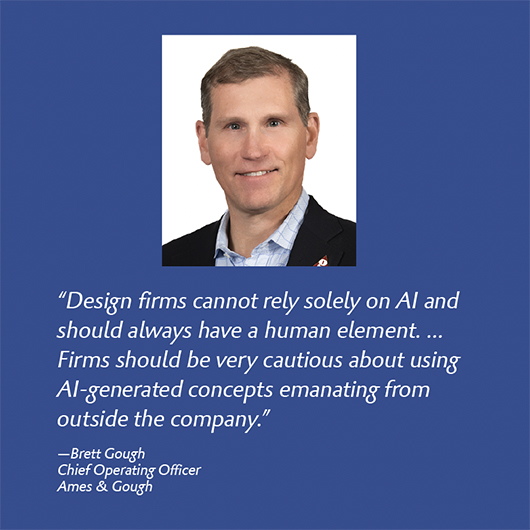
“Design firms cannot rely solely on AI and should always have a human element,” he says. “Use of AI should be based on a firm’s internal documents and designs. Firms should be very cautious about using AI-generated concepts emanating from outside the company.” A&E firms can expect their PL insurers to inquire about measures taken to address AI risk, including management responsibility and employee training, according to Gough.
In lawyers PL, Medina finds that plaintiffs are using AI to expand their opportunities to instigate litigation. “We’re seeing plaintiff firms use data to identify targets, develop litigation strategies, and uncover patterns that support claims,” she says. “These could contribute to higher claim frequency and severity over time.”
She adds that, as cyber and professional liability become increasingly interconnected, some insureds are seeking flexibility and simplicity by acquiring embedded, endorsed, and/or stand-alone cyber coverage through a single carrier.
“For agents and brokers, this reinforces the importance of helping clients understand how their risk profiles may be shifting,” she says. “While the underlying exposures may vary by industry, the common theme is that clients are operating in a more complex environment, making comprehensive PL protection more important than ever.”
For more information:
Admiral Insurance Group
admiralins.com
Ames & Gough
amesgough.com
Gateway Specialty Insurance
gatewayspecialty.com
The Hanover
hanover.com
Rockwood Programs
rockwoodinsurance.com
The author
Joseph S. Harrington, CPCU, is an independent business writer specializing in property and casualty insurance coverages and operations. For 21 years, Joe was the communications director for the American Association of Insurance Services (AAIS), a P&C advisory organization. Prior to that, Joe worked in journalism and as a reporter and editor in financial services.