Don’t assume that ownership transfer
and leadership transfer are the same thing
By Angela Adams
During the early days of COVID, I found myself at home with something most business owners rarely have: time to think.
Like many people, I was worried about the future. The normal rhythm of work had stopped, the office was empty, and there was no packed schedule to distract me from the questions I had avoided.
One of them kept returning, and the more I tried to ignore it, the louder it became: What would happen to my company if something happened to me?
I started my insurance agency consulting firm from scratch in 2001 and spent more than two decades building it. I knew our clients, our employees, our systems and our history. I understood why certain decisions were made because, in many cases, I had been the one making them. That involvement had helped us grow, but sitting at home during a global pandemic, I began to see the danger in it, too. I realized that if I disappeared tomorrow, my family, my employees and my clients would all be affected in ways I had never fully considered.
I realized that I had built a successful company, but I wasn’t sure I had built one that could keep moving forward without me.
Agency owners spend years building something valuable. We develop carrier relationships, recruit employees, serve clients, manage financials, and solve the never-ending stream of problems that come with running a business.
Yet many of us postpone one of our most important responsibilities: developing the people who can lead alongside us now and eventually carry the company forward without us. We may have a perpetuation agreement, a valuation, or even a future owner in mind, but ownership and leadership are not the same thing.
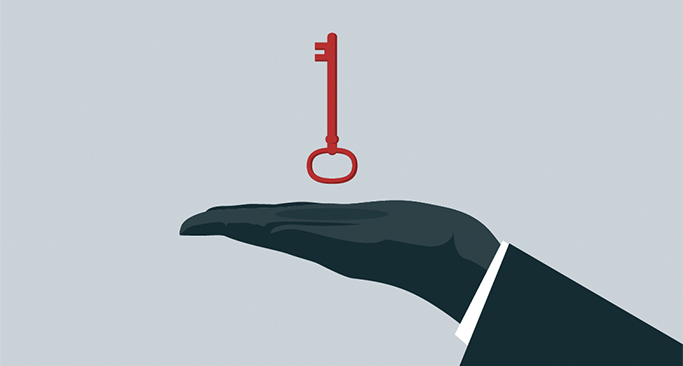
A name can be added to an agreement. Leadership cannot be transferred with a signature. And when every decision, problem, and opportunity still depends on one person, the business cannot grow as freely, or as effectively as it should.
The biggest succession mistake that agency owners make is assuming ownership transfer and leadership transfer are the same thing.
I began looking for a leadership development program that could help me prepare the next generation. I thought I would find one.
My father attended a Dartmouth executive development program for a summer and often shared leadership lessons and ideas he had learned there. Those conversations stayed with me and shaped my belief that leadership development should be deeper than teaching someone how to supervise employees. It should help people understand themselves, communicate with different personalities, recognize how an organization really works, and learn to think beyond the problem directly in front of them.
I searched for a program that brought all those pieces together. I found management courses. I found communication seminars and strategic planning workshops. I could not find one complete program that included everything I believed an emerging leader needed and developed those skills in the right order.
So, I decided to build it myself. A year-long Leadership Development Program centered on four essential competencies: self-awareness, effective communication, organizational awareness, and strategic thinking.
Rather than relying on lectures alone, participants would learn through seminars, books, presentations, coaching sessions, and collaborative projects to challenge them to apply what they were learning.
Your next leaders may already be there
The first step was not writing the curriculum. It was deciding who should be in the room.
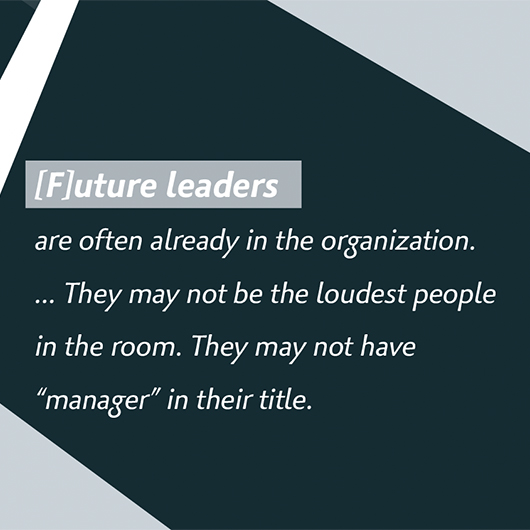
When owners think about succession, they often begin by looking only at agency producers or outside the agency. They imagine finding someone with the perfect résumé who can walk in and take over. Now, sometimes an outside hire is necessary, but I have learned that future leaders are often already in the organization.
They may not be the loudest people in the room. They may not have “manager” in their title. It might be the employee who stays calm when everyone else is overwhelmed, the person who asks why a process no longer works, or the team member whom others naturally seek guidance from.
Leadership potential often appears in small moments, long before it appears on an organizational chart.
That does not mean that every strong employee should become a leader. A talented account manager or producer may be exceptional in their role without wanting the responsibility of leading others. The right candidates must be selected thoughtfully. I look for curiosity, accountability, emotional maturity, openness to feedback, and a genuine desire to understand the business beyond one job description.
For my program, I was not looking for finished leaders. I was looking for people who were willing to grow.
Before you lead others, you need to understand yourself
I felt it was important to begin the program with self-awareness because leadership problems are often self-awareness problems in disguise. Before people can lead others well, they need to understand how they communicate, make decisions, respond to pressure and affect the people around them.
The goal is not to manufacture one “ideal” leadership personality. Some leaders are visionary. Others are analytical, steady, persuasive, structured or highly relational. Each style brings value, and each comes with risks. Self-awareness gives people the chance to use their strengths intentionally.
I began to see participants recognize themselves in new ways. Some discovered that the trait they were most proud of could also become a weakness when overused. Others realized that people who approached work differently were not necessarily difficult—they simply saw the world through another lens.
Those moments were important because they changed how participants showed up long after the class ended.
Communicate in a way others can hear
Once participants developed a stronger understanding of themselves, we turned our attention to how they communicated with others.
Leadership often succeeds or fails through communication. Future leaders must learn to listen as well as they speak, adapt their approach to different personalities and generations, coach instead of simply direct, and handle difficult conversations with honesty and respect.
Many workplace issues that appear to be operational are communication problems in disguise. As participants became more aware of how they communicated, they began listening more carefully, asking better questions, and approaching difficult conversations with greater confidence.
These changes helped them build stronger relationships and create healthier, more collaborative teams.
Seeing the organization as a whole
From there, we broadened the focus beyond individual relationships and asked participants to consider how the entire organization worked together. Emerging leaders often begin by focusing on their own department or area of expertise. Great leaders learn to see beyond those boundaries.
We challenged participants to understand how each department contributed to the client experience, how decisions in one area affected another, and how finance, operations, sales, marketing, and service depended on one another.
This broader perspective helped participants recognize that leadership required more than performing their own responsibilities well. It required understanding the business as an interconnected system and considering how each decision could affect employees, clients, and the organization as a whole.
Learning to think like an owner
The final area of focus was strategic thinking. While high performers are often exceptional at solving the problems directly in front of them, leaders must learn to anticipate tomorrow’s opportunities and challenges.
Participants learned to evaluate market trends, understand financial performance, analyze organizational strengths and weaknesses, and ask bigger questions about where the organization should be heading. That shift from reacting to planning is one of the defining differences between management and leadership.
Throughout the year, participants completed assignments, led discussions, participated in one-on-one coaching sessions, and presented solutions to real organizational challenges. This application was important. I did not want people to memorize leadership terminology and then return to work unchanged.
As the year progressed, I began noticing a difference. Employees who once hesitated to speak began presenting ideas with greater confidence. People who had focused primarily on their own responsibilities started considering how a decision might affect another department, the client experience, or the future of the company.
One of the hardest transitions for an emerging leader is moving beyond the immediate task. Most high-performing employees became successful because they are dependable doers. They answer the email, solve the issue and finish what is in front of them.
While leaders also execute, they must learn to look up. In one exercise, we use the perspectives of an ant, a rabbit, and an eagle. The ant sees the task directly in front of it. The rabbit sees farther across the field. The eagle sees the entire landscape. A growing agency needs all three perspectives.
The challenge is knowing when to remain close to the details and when to step back and ask the bigger questions: Where are we going? What are we missing? What should we stop doing? What will our clients and employees need from us next?
You cannot wait until you need a leader
Dozens of our employees have now completed the program, and many have moved into leadership roles as our company has grown. Others have become stronger communicators, collaborators, and strategic contributors, even when they did not immediately step into management.
The program did not make every participant the same. That was never the goal. It helped them become more prepared, more confident, and more aware of the responsibility that comes with influencing others.
Leadership development can feel important but not urgent—until a key employee leaves, an owner becomes ill, growth outpaces the current leadership team, or someone is promoted before they are ready. At that point, the agency is no longer developing a leader. It is hoping someone can rescue it.
Leadership is multiplication
One of the biggest surprises was realizing that leadership development did not just improve the participants. It improved the people around them, too.
Managers began coaching instead of solving every problem themselves. Departments collaborated more effectively. Employees became more engaged because they felt heard and empowered. Leadership was not confined to a handful of individuals; it began multiplying throughout the organization.
You cannot wait until you need a leader to begin building one. Twenty-five years after starting my company, I have come to believe that one of an owner’s greatest responsibilities is not remaining indispensable. It is building people who can carry the organization forward with confidence, judgment, and a deep understanding of what the company stands for.
Looking back six years later, I can honestly say that one of the lasting legacies of COVID for our company is that it pushed us to develop leaders intentionally. As difficult as that time was, it made us a stronger organization.
The question COVID forced me to ask changed the trajectory of our company. Dozens of employees have now completed the program, many have grown into leadership roles, and leadership is no longer concentrated in one person. Perpetuation is not simply deciding who will own the agency next. It is preparing the people who will be ready to lead it.
The author
Angela Adams is the founder and president of Angela Adams Consulting, one of the nation’s leading consulting firms serving independent insurance agencies. Since founding the company in 2001, she has helped thousands of agencies improve profitability, strengthen operations, develop leaders, and prepare for the future through consulting, accounting, and business support services.
Angela’s insurance career began in 1985 in agency accounting. Prior to launching her consulting firm, she served as an agency owner, chief financial officer, and commercial lines and marketing manager. Her firsthand experience gives her a practical understanding of the operational, financial, and leadership challenges agencies face every day.
A nationally recognized speaker and author, Angela frequently presents for industry organizations and conferences, including NetVU, and works closely with leading technology providers, to help shape solutions that meet the evolving needs of independent agencies. Under her leadership, Angela Adams Consulting has grown to a team of more than 100 professionals dedicated to helping agencies build stronger, more profitable businesses.