
Addressing technology, governance,
and growth issues identified in agent and broker survey
By Brooke Liu
Few areas invite more questions—or offer more opportunities for learning—than technology. MarshBerry’s 2026 Technology & Governance Report examines how firms are approaching key issues including AI, data and analytics, cybersecurity, leadership and governance, perpetuation, and strategic planning. The study highlights patterns in how firms are investing, where they face operational constraints, and which capabilities may shape long-term performance.
Report overview
The Technology & Governance report contains data from 100 insurance agents and brokers and identifies trends that help firms prioritize, set goals, and benchmark against peer performance. Here are the key themes that emerged from the research.
- Technology: Broad adoption, limited integration. Firms are showing strong interest in AI, automation, and system upgrades, but progress is slowed by fragmented tools, incomplete data integration, and time/resource constraints. While 74% of firms indicate some degree of AI use, their activity is mainly exploratory and relatively few are seeing strong results in any one particular area. Currently, technology is used most frequently for reducing administrative work, improving efficiency, and supporting growth without adding headcount.
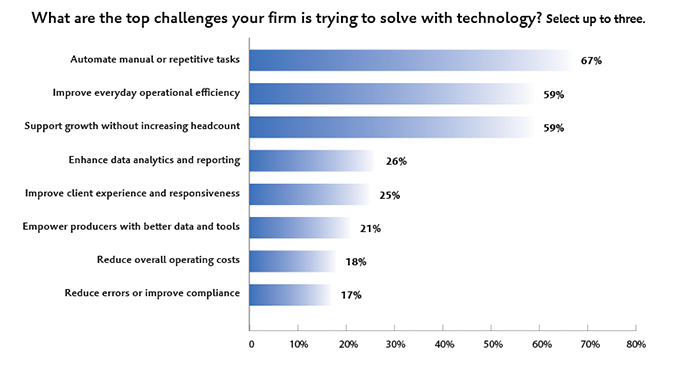
Many firms feel their current systems do not support scalable growth, with the biggest obstacles including time constraints, implementation complexity, integration problems, and lack of training. In the future, respondents expect technology to play an important role in addressing business challenges including automating manual or repetitive tasks (67%), improving everyday operational efficiency (59%), supporting growth without increasing headcount (59%), and more. (See chart below.)
- Data and analytics: High interest, mixed confidence. While most firms believe they can extract some insights from data, data organization remains a challenge, limiting its usefulness in AI and automation initiatives.
Only a small minority of firms have dedicated data analytics teams, instead relying on ad hoc support or individual employees with analytics responsibilities embedded in other roles. This decentralized structure limits consistency, quality, and strategic use of data.
Firms that want to expand automation, predictive analytics, or AI must prioritize foundational data work first, including establishing formal data governance, streamlining, and integrating systems, and assigning clear ownership of data quality. Doing so enables firms to move from reactive reporting to proactive, insight-driven decision-making.
These results highlight an important gap: Firms are unlikely to realize the full value of AI without a strong, reliable data foundation.
- Corporate governance: Underdeveloped structures limit scale. Governance is a major determinant of a firm’s ability to grow, yet many firms lack the necessary structure and rigor, with only 34% of firms having a formal Board of Directors. Though boards have numerous, highly significant responsibilities—strategic planning, CEO evaluation, budget approval, acquisition oversight, and compensation decisions—only 18% of companies offer training or education on these board responsibilities.

Non-owner or external advisors serve on 50% of boards, often bringing needed expertise. At the same time, nearly half of firms use indefinite board terms, reducing rotation and fresh perspective. Most boards meet quarterly, but governance discipline, such as formal reviews, is inconsistent.
- Perpetuation and strategic planning: Confidence without structure. While leaders express optimism about next-generation talent, most firms lack the formal mechanisms to ensure orderly transition, as evidenced by the fact that only:
- 48% have a formal succession plan
- 32% have identified a future CEO
- 32% have leadership development programs
- 20% offer employee stock ownership
Obstacles to perpetuation can be overcome by creating a clear and specific roadmap, including establishing timelines, identifying qualified candidates, and raising capital to help meet perpetuation goals.
Relating to strategic planning, most firms have growth goals and update plans annually, but only 26% believe their planning process is highly effective. Effective firms translate long-term strategies into daily execution, link incentives to goals, and review progress throughout the year.
Action plan for firms
Across technology, governance, and perpetuation, firms know what they need to change—but execution lags intention. The strongest performers will be those that:
- Build a clean, integrated data foundation
- Move from AI experimentation to workflow enablement
- Establish formal governance structures with accountability
- Treat strategic planning as an ongoing management discipline
- Implement structured leadership development and succession pathways
These capabilities will determine a firm’s ability to scale profitably, manage risk, and grow enterprise value in the coming decade.
Built on data collected from insurance agents and brokers nationwide, the MarshBerry 2026 Technology & Governance Report examines how firms are approaching technology investment, artificial intelligence, data and analytics, cybersecurity, corporate governance, and succession planning—and where gaps in execution continue to limit results. The findings reinforce a consistent theme we see in our work every day: Leaders understand what must change, but fewer have made the structural decisions needed to execute at scale. Learn more and purchase the full report by visiting bit.ly/RN-MB26.

The author
Brooke Liu is a Senior Vice President at MarshBerry, a global leader in financial advisory and consulting services serving the insurance brokerage and wealth management industries. Brooke’s operational expertise, product development experience, and servant leadership style are instrumental in helping MarshBerry clients achieve their growth goals through the invaluable MarshBerry programs such as Connect executive peer exchange. Brooke brings over a decade of experience in consulting, executive coaching, and program development.
MarshBerry is a global leader in investment banking and consulting dedicated to helping insurance brokerages, and firms in the wealth management industry and the accounting and tax industry, achieve sustained growth and value for every stage of ownership. With a legacy spanning over 40 years, MarshBerry offers an extensive suite of services, including investment banking (merger & acquisition advisory; capital raising), financial consulting (strategic planning; valuations; perpetuation planning), organic growth consulting (leadership, sales & talent solutions), executive peer exchange, agency network and market intelligence and performance benchmarking.
Contributor
Dani Zhelezova is the Vice President of Business Intelligence and leads the development of MarshBerry’s proprietary suite of analytics and research products. She is passionate about developing innovative solutions for clients that use data to solve problems and make informed decisions. Since joining MarshBerry in 2013, Dani has played a vital role in the development of PHP, the Value Intelligence (VI) Portal, and Producer Stack Ranking to deliver new insights and a seamless client experience.