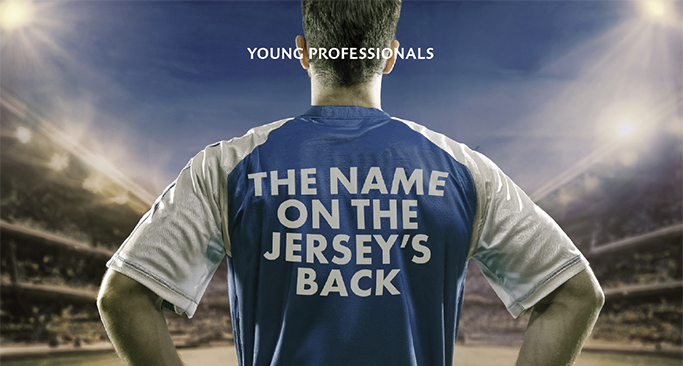
Tips for establishing a reputation
as you start your insurance career
By Ryan Spalding
You might wear a few different
jerseys during your career. The only
name that will follow you everywhere
is the one on the back. Build it and protect it.
When you enter this industry, you are handed a jersey. It has a firm’s name on the front, whether that is the name of a company you started or the name of a company you joined. It carries history, reputation, and market access. It carries carrier relationships, brand equity that opens doors, and credibility with underwriters and clients before you say a word. It carries loss experience, internal resources, and infrastructure that shape how business gets done and what is possible. All of those things matter.
In the insurance industry, the name on the back of that jersey is what matters.
As you get started in your career, you will establish a reputation that will follow you throughout your career with your insurance trading partners and your clients. Insurance is a relationship business, and that is why the name on the back of the jersey is what matters. The following tips are meant to help you establish that reputation within the industry.
Be reliable. Before anyone cares about your strategy, knowledge, creativity, or credentials, they will evaluate whether they can count on you. Are you someone who does what you said you were going to do, when you said you were going to do it? The insurance industry is built on predictability. To establish reliability, define expectations, document the commitments you make, and close the loop on them.
Be clear. Insurance is confusing to most people, and confusion creates hesitation. You can create clarity by defining the issue, outlining the pros and cons of each option, and providing a roadmap of the next steps.
The insurance industry loves acronyms, and so do many of the industries you serve. Over the course of your career, you will learn a lot of industry jargon. You need to be able to translate that jargon into simple language that your clients understand, while also being able to use that same language to build credibility with trading partners.
Be responsive. Move fast and break things was Facebook’s motto until 2014, and it is likely one of the reasons the company grew as quickly as it did. Insurance is a time-sensitive business, and the speed of your responsiveness reduces uncertainty.
Too often, people think speed alone defines responsiveness. Often, clear and timely communication cuts through ambiguity, or what the industry calls suspense. Make it a point to acknowledge immediately, move the process forward when you can, and communicate next steps to all stakeholders with a clear deadline.
Specialization. The last recommendation to establish your reputation is to become a specialist. Learn the language your clients use, study how their operations work, understand what headaches their industry experiences, and spend time in their environments.
Do not stop at surface-level knowledge. Make it a point to understand what actually drives losses, what creates friction in daily operations, and pay attention to patterns across your accounts. Once you are a specialist, you can anticipate issues before they arise and become a comprehensive solution provider.
Conclusion
Reputation compounds slowly and collapses quickly. As Warren Buffett put it, it takes twenty years to build a reputation and five minutes to ruin it.
You might wear a few different jerseys during your career. The only name that will follow you everywhere is the one on the back. Build it and protect it.
The author
Ryan Spalding is the managing advisor of Gibson’s Chicago practice. He built his career as a contrarian fixer of complex risks, trading standard brokerage fluff for radical transparency and operational reality.