What commission leakage
reveals about your whole business
By Anupam Gupta
Most agency principals have made peace with commission reconciliation. Carrier statements arrive in dozens of formats—spreadsheets, PDFs, portal exports, paper. Someone on the accounting team spends hours, sometimes days, matching what the carrier says they paid against what the agency management system (AMS) says it earned.
The numbers rarely line up the first time. Discrepancies get chased down where they can be, written off where they cannot. Every month, a non-trivial amount of earned commission slips through the cracks.
It is one of those quiet operational realities of running an independent agency. Few principals want to audit it too closely because the answers are uncomfortable, and the fix has always seemed harder than the loss. So the work continues, the leakage continues, and the agency moves on to the next priority.
Here is the argument I want to make: Commission leakage is not really a finance problem. It is a diagnostic. If your agency is losing money on commission reconciliation, it is almost certainly losing efficiency, revenue, and risk control elsewhere, too, because the root cause is the same. Manual data handling at scale eventually breaks down everywhere it touches.
What the numbers are actually telling you
When a reconciliation team consistently finds discrepancies between carrier statements and AMS records, the discrepancies themselves are not the most interesting part. The interesting question is why the data does not match in the first place.
The answer, almost always, is that the same policy information has been entered, re-entered, and reformatted by humans across multiple systems and points in time. First, a producer captures it during the sale, and then a CSR enters it during binding. Then, the carrier records it differently in their own system. A statement is generated weeks later in yet another format. By the time the data reaches reconciliation, it has been touched by multiple people and multiple systems, each with its own conventions and opportunities for error.
Commission leakage is the visible, quantifiable consequence of that fragmentation. But the same fragmentation is producing other consequences elsewhere in the agency that are harder to see on a balance sheet.
The operational tax you are already paying
Consider what manual data handling looks like across the rest of the agency.
On the renewal side, account managers spend significant time pulling together information that is technically already in the system but scattered across policies, notes, claims records, and email threads.
A thorough pre-renewal review of a mid-market commercial account can take an experienced producer 30 to 45 minutes of file analysis before the client conversation even begins. Across a full book of business, that math becomes unforgiving. Most agencies end up triaging, applying their deepest preparation to the largest accounts and handling smaller ones with less rigor.
On the producer side, the same problem manifests as missed cross-sell and round-out opportunities. The data that would surface a client’s coverage gap is sitting in the AMS. Think a homeowners policy with two autos but no umbrella, a commercial client whose property values have outpaced their building limits or a contractor whose vehicle additions have not been matched by inland marine updates. But surfacing this requires that someone go looking. Most of the time, no one does.
On the E&O side, the exposure compounds from policy details that are inconsistent across systems, certificates issued from outdated templates, and endorsements logged in one place but not reflected in another. These are exactly the conditions that produce E&O claims. The same manual processes that cause commission leakage are quietly building up E&O risk.
These are not separate problems. They are different symptoms of the same underlying condition: an agency operating model that depends on humans to move data accurately between systems that were never designed to talk to each other.
Where AI and automation are actually delivering lift today
There has been no shortage of AI hype directed at the insurance industry. Some of it is warranted. Much of it is not. The honest answer to “where is AI working in agency operations today” is more specific and more measured than the marketing suggests.
AI is delivering measurable lift in the places where the work is structured, repetitive, and high-volume. In other words, it’s the work that humans do not particularly enjoy and do not particularly do well at scale. Three areas stand out:
- Document and statement processing. AI can read carrier commission statements in any format, normalize the data, match it against AMS records, and flag discrepancies for human review. What used to be a multi-day reconciliation cycle can become a same-day exception review.
- Policy and account intelligence. AI can continuously analyze an entire book of business, flagging coverage gaps, surfacing cross-sell and round-out opportunities, and benchmarking limits against market norms. The agent’s role does not diminish; it sharpens. Producers walk into renewal conversations with specific, data-driven observations rather than generic talking points, and they walk into new business meetings with sector-level insight rather than just a quote.
- Assisted servicing and data entry. AI-powered data extraction can pull policy information directly from carrier documents and populate AMS fields, eliminating the rekeying that creates the data inconsistencies in the first place. This is where the diagnostic comes full circle: The same automation that prevents commission leakage at the back end prevents the data fragmentation that caused it at the front end.
AI-powered technology is moving fast, but the agencies seeing real returns today are the ones using AI to augment specific, well-defined workflows, not to replace human judgment in the parts of the business where judgment is the whole point.
A diagnostic framework for agency principals
If you want to assess your own agency’s operational exposure, the questions are simpler than the answers. Ask your team about:
- Reconciliation. How much earned commission does our team estimate that we leave on the table each year because of statement discrepancies we cannot fully resolve? If the honest answer is “we are not sure,” that itself is a finding.
- Renewals. What percentage of our renewal conversations includes a specific, data-driven observation about the client’s evolving risk profile versus a standard premium-and-terms review? If most renewals default to the standard script, your producers are not lacking insight; they lack the time to find it.
- Round-out and cross-sell. Of our existing clients, how many have an obvious coverage gap that no one has surfaced in the last 12 months? Most agencies are surprised by the volume of opportunity sitting inside their current book.
- Data entry and rework. How many times does the same piece of policy information get manually entered or reformatted between the moment we win the business and the moment we reconcile the commission? Each touch is a potential failure point.
- E&O exposure. When was the last time we conducted a systematic review of policy details for consistency across our AMS, certificate templates, and carrier records? If the answer is “during the last audit,” your exposure is higher than you think.
The agencies that work through these questions honestly tend to discover that the cost of their current operating model is significantly higher than the cost of changing it. Commission leakage was just the most visible piece.
The real opportunity
Commission reconciliation will not be the headline story when agencies look back on this period of operational change. The headline will be that the agencies that took their operational data seriously and built the infrastructure to act on it became materially better at their core job. They retained more clients, wrote more new business within their existing relationships and reduced their E&O exposure. They gave their best people more time to do the work that drew them to the industry in the first place.
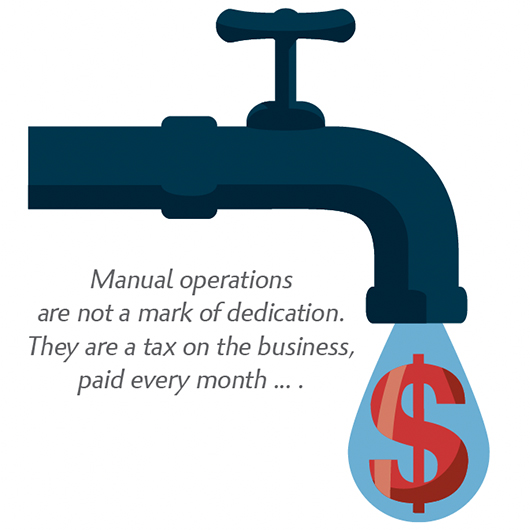
Manual operations are not a mark of dedication. They are a tax on the business, paid every month, through commission leakage, missed renewals, unclaimed opportunities, and risk. The encouraging news is that the tools to reduce that tax are mature, available, and increasingly built directly into the systems that agencies already use.
The first step is the willingness to look at the numbers. The rest follows from there.

The author
Anupam Gupta is chief product officer at Applied Systems Inc. He is responsible for the company’s product vision and product management teams. Anupam was formerly CPO at 4C Insights, a sophisticated data and analytics SaaS provider to the AdTech/MarTech industries (which was acquired by Mediaocean, the mission-critical platform for omnichannel advertising with more than $200 billion in annualized media spend managed through its software) connecting the ecosystem of agencies, brands, media, technology, and data. As CPO of the combined companies, he spearheaded their product transformation to the cloud, adding new products fueled by data and intelligence infused in the core workflow. Previously, he led product organizations for several tech companies, including Vubiquity, Mixpo, and Microsoft among others.