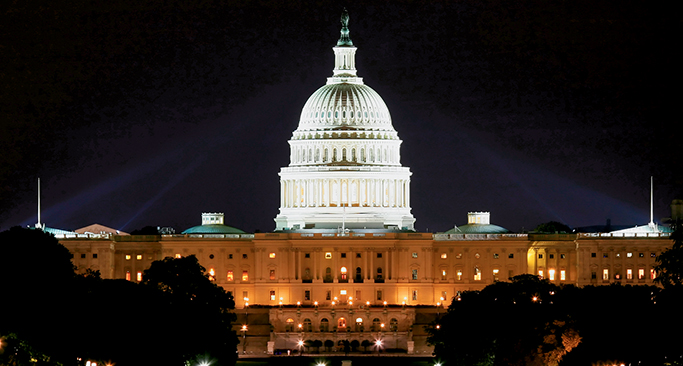
Even a dysfunctional Congress
receives interesting proposals to consider
At the time of this writing, … Congress has
before it two pieces of legislation of interest to the insurance sector.
By Kevin P. Hennosy
Writing about proposed congressional legislation is always fraught with peril. One might say, it is an uninsurable risk. The dangerous nature of that endeavor is usually centered upon the fluidity of the legislative process. In the time-period between filing a column and publication, any foolish amendment can change the meaning of a bill.
However, in these days, when Congress may or may not be populated with “The Un-Dead,” the risk of something, anything, getting done is so minute that even a grizzled commentator on insurance law and regulation can be tempted to live a little dangerously.
At the time of this writing, the Zombie Congress has before it two pieces of legislation of interest to the insurance sector. The first one deals with a particularly inventive interpretation (i.e., wrong) of the McCarran-Ferguson Act of 1945. The second bill is not just a bi-partisan work product but a collaboration of one of the most conservative and most liberal senators currently seated in that chamber.
As said above, the Zombie Congress is not likely to pass anything this year beyond naming post offices and fulfilling requests for American Flags to be flown for a second over the Capitol.
To fetch
Several times through the past 26 years, this column has mentioned the term “Fetcher Bill.” Aging political junkies love the term and often use it when analyzing an odd legislative proposal.
(William) Safire’s Political Dictionary contains an entry for Fetcher Bill and cites the Oxford English Dictionary (OED) definition of “fetch.” As a verb, the word means “go get.” As a noun, the same source lists “contrivance, stratagem, or trick” in the definition. Safire’s Dictionary limits the use of “Fetcher Bill” to the solicitation of a bribe.
The late Chicago-based political columnist Mike Royko, in his biography of Mayor Richard J. Daley entitled Boss, uses the term Fetcher Bill in the same limited way, to illustrate the corruption of the Illinois State Legislature: It would fetch “a visit from a lobbyist bearing a gift.”
Perhaps the generation of usage that passed between the publication of the two definitions above and this writer’s experience around legislatures expanded the meaning of Fetcher Bill.
In this writer’s experience, the purpose of Fetcher Bills was not limited to obtaining bribes. Other “things of value” were obtained through even the circulation of a Fetcher Bill, such as, legal (but corrupt) campaign contributions or securing a lobbyist’s help supporting or opposing another bill or policy.
Of course, not every piece of legislation with a longshot at passage is a Fetcher Bill. Sometimes bills become longshots because of a dysfunctional legislature.
Downing bill
Which brings us to the ‘‘McCarran-Ferguson Restoration Act,” introduced by Rep. Troy Downing (R-Mont).
Rep. Downing is a first term member of Congress, who some readers will recognize as the former Montana State Auditor/Insurance Commissioner. In 2025, upon being sworn into Congress, he introduced a bill to eliminate the Federal Insurance Office (FIO). Rep. Downing expanded that legislation to draft the McCarran-Ferguson Restoration Act.
The National Association of Insurance Commissioners (NAIC) issued a news release to endorse the bill, “which reaffirms the states’ longstanding role as the primary insurance regulators in the United States.”
The primary purpose of the Downing legislation is the elimination of the FIO, which Congress created with a specifically crafted insurance provision of the Dodd-Frank Act of 2010. Policymakers who supported the FIO’s creation were concerned that state officials were not always considering systemic risk and pointed to state officials’ failure to regulate the bond-default insurance products that led to the American International Group (AIG) financial failure.

The opponents of the FIO prefer to argue that the agency duplicates state action. This argument sounds disingenuous. When pressed, most advocates for the insurance sector will admit that their concern is that the FIO does harm to insurance operations through expanded regulatory oversight.
Downing’s legislation is immensely popular with trade groups representing mutual insurers, agents, brokers, and property/casualty carriers. Rep. Downing’s office issued its own news release, which included the following endorsement quotes from the insurance sector.
The consensus is clear: “Regulatory authority over insurance should be left to the states,” said Jimi Grande, NAMIC senior vice president of federal and political affairs. “Rather than informing federal policymakers, the [FIO] has for years duplicated the work of state regulators, routinely exceeding statutory guidance and inflicting burdensome costs that are ultimately paid by consumers. As a former state insurance commissioner, Congressman Downing knows this all too well, and NAMIC appreciates his leadership in stopping this wasteful federal overreach.”
“We are thankful to Rep. Downing for his work to protect the integrity of McCarran-Ferguson and the state-based regulatory system. Over the years, the [FIO] has shown to have questionable value for insurance markets as well as consumers,” said Big “I” Senior Vice President of Federal Government Affairs Nathan Riedel. “As the largest association representing independent insurance agents and brokers, the Big ‘I’ supports eliminating the FIO, and affirming the valuable work that state regulators do.”
“The McCarran-Ferguson Restoration Act safeguards the proven state-based system of insurance regulation by repealing the Federal Insurance Office—an unnecessary federal bureaucracy created under the 2010 Dodd-Frank Act,” said PIA Chief Executive Officer Mike Skiados. “For more than a century, state regulators have effectively protected both consumers and the insurance marketplace, and they remain best positioned to do so moving forward. PIA appreciates Rep. Troy Downing for his leadership and commitment to preserving the state insurance regulatory system.”
“The McCarran-Ferguson Restoration Act is a critical measure to preserve the strength of our state-based system of insurance regulation–a framework that has protected consumers and ensured market stability for decades,” said Sam Whitfield, APCIA’s senior vice president of federal government relations and political engagement. “The bill also equips the Treasury Department with tools to advocate for this proven system internationally, while appropriately eliminating unnecessary powers of the Federal Insurance Office. APCIA thanks Rep. Downing for his leadership and commitment to working collaboratively with stakeholders to advance this important legislation.”
Of course, regular readers of this column know that description of the bill offered by the NAIC ignores the Commerce Clause of the United States Constitution, which reserves jurisdiction with the Congress for interstate commerce. The states’ jurisdiction over insurance is the result of an act of Congress, which makes a limited and contingent loan of congressional jurisdiction to the states for the purpose of regulating insurance.
So, if a piece of legislation promises to “restore” the McCarran-Ferguson Act, an informed observer would expect that the act was amended at some point. The McCarran-Ferguson Act has not been amended since the late 1940s, which only delayed the implementation date of the legislation.
The Dodd Frank act is completely consistent with the McCarran-Ferguson Act’s provision preserving congressional authority to enact laws that “specifically relate[s] to the business of insurance.” Any informed layperson can see that the creation of the FIO does no harm to the McCarran-Ferguson framework.
In a normal Congress, a bill that garners this kind of lobbying support would stand a good chance at passage. Alas, this is not a normal Congress.
Hawley-Warren
Another piece of legislation that is interesting but will probably die in this Zombie Congress is offered by Sen. Josh Hawley (R – Mo.) and Senator Elizabeth Warren (D – Mass.).
If adopted, the bill will aim at the conglomeration of health insurance, healthcare providers, and pharmaceutical companies.
Is it even insurance?
According to a 2006 report published by the Government Accountability Office (GAO), insurance shows the following traits.
- indemnification, which is the payment for losses actually incurred
- the ability to make reasonable estimates of future losses
- the ability to express losses in definite monetary amounts
- the possibility of adverse, random events occurring outside the control of the insured
As a commentator, and not a reporter, this writer will opine that the bill targets entities that do not meet the definition of insurance. These conglomerates do not transfer and spread the risk of loss. No, they just move money from one pocket to another in the same pair of pants.
The legislation will:
Prohibit a parent company from owning a medical provider or management services organization and a pharmacy benefit manager (PBM) or an insurer
Prohibit a parent company of a prescription drug or medical device wholesaler from owning a medical provider or management services organization
Require that a company violating these conflicts of interest come into compliance within one year of the bill’s enactment
Create automatic penalties if a company does not comply promptly, including disgorgement of profits and forced sales of assets
Enable the Federal Trade Commission (FTC), Department of Health and Human Services, Department of Justice (DOJ), state attorneys general, and private parties to bring lawsuits against violators
Allow the FTC and DOJ to review and block future actions that would recreate the conflicts of interest prevented by the bill
Sen. Hawley explained his reason for introducing the bill as follows: “Americans are paying more and more for healthcare while the quality of care gets worse and worse. In their quest to put profits over people, Big Pharma and the insurance companies continue to gobble up every independent healthcare provider and pharmacy they can find. Working Americans deserve better. This bipartisan legislation is a massive step towards making healthcare affordable for every American.”
As for Sen. Warren, she observed: “Our bill would be a monumental step towards ending the stranglehold that corporate giants have on our broken healthcare system.”
“There’s no question that massive healthcare companies have created layers of complexity to jack up the price of everything from prescription drugs to a visit to the doctor. The only way to make healthcare more affordable is to break up these healthcare conglomerates,” she added.
So, shoo shoo, Zombies, grownups have work to do!
The author
Kevin P. Hennosy is an insurance writer who specializes in the history and politics of insurance regulation. He began his insurance career in the regulatory compliance office of Nationwide and then served as public affairs manager for the National Association of Insurance Commissioners (NAIC). Since leaving the NAIC staff, he has written extensively on insurance regulation and testified before the NAIC as a consumer advocate.