What London taught us about
relationships, risk and the future of insurance
At Lloyd’s, no one was in a hurry to “get to the deal.
” There was conversation before business. Time spent without an agenda … .
By Carolyn Smith, APR, CRA, TRA
Eighteen of us stepped off the plane in London expecting to learn about market structure, global capacity, and maybe a few underwriting nuances we could bring back home. What we didn’t expect was to be completely reoriented around something far more fundamental: relationships.
Earlier this year, members of the Beyond Insurance Global Network (BIGN) walked into the C J Coleman offices and onto the historic floors of Lloyd’s of London with a familiar American mindset: Move efficiently, get aligned, get to “yes.” After all, that’s what we’ve been taught. In the U.S., speed signals competence, efficiency signals professionalism, and closing signals success.
But within hours, it became clear: We were playing a different game. Or more accurately, we were playing the same game by very different rules.
At Lloyd’s, no one was in a hurry to “get to the deal.” There was conversation before business. Time spent without an agenda. Questions that had nothing to do with submissions or pricing. And what initially felt like a slower pace revealed itself to be something else entirely: a deliberate investment in social capital.
As David MacPherson at C J Coleman explained, “In the global marketplace, the British emphasis on cultivating strategic relationships contrasts sharply with the efficiency-driven, ‘get to yes’ approach often seen in the United States. Nowhere is this relational mindset clearer than at Lloyd’s of London.
“Operating at the heart of the United Kingdom’s commercial culture, it reflects a world where trust, rapport, and social capital are essential from the very first conversation,” he explained. “While Americans may view a closed deal as the beginning of a partnership, at Lloyd’s the relationship is the prerequisite, the foundation upon which every contract is built.”
The long game in action
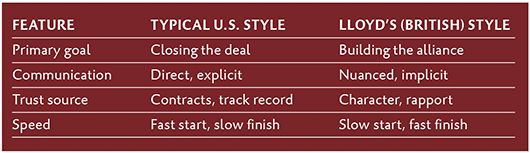
American business culture often celebrates speed—fast starts, quick wins, rapid execution. But that speed comes at a cost. Deals close quickly, but relationships can remain shallow. When pressure hits, those relationships are more likely to fracture.
The British approach flips that dynamic. They start slower, but they finish faster. Because by the time a deal is on the table, the trust is already there.
What looks like “small talk” to an American professional is, in reality, the work itself. Conversations over lunch, time spent networking at the pub, and informal exchanges outside the boardroom are all part of a structured, intentional process: understanding the person behind the business.
They are asking questions we don’t always think about asking:
- Can I trust this person when something goes wrong?
- Will they show up when the pressure is on?
- Are they someone I want to be tied to when the stakes are high?
By the time formal negotiations begin, much of the real decision-making has already taken place.
What they’re doing differently
To understand why this works, it helps to break it down into three distinct practices.
First, social front-loading. In the U.S., we treat small talk as a warm-up. At Lloyd’s, it’s a vetting process. Those early conversations aren’t filler—they’re where trust is built, character is assessed, and long-term alignment is tested.
Second, high-context communication. Because so much time is invested upfront, British professionals develop a kind of shorthand. They don’t need to spell everything out in exhaustive detail, because they already understand each other’s values and intentions. That makes it easier to navigate complex issues without immediately escalating to conflict.
Third, the “pub and tea philosophy.” Moving conversations out of formal environments isn’t about being casual. It’s about removing hierarchy. When titles fade into the background, you get to see the real person, and that’s the person you’ll be relying on when a claim gets complicated or a deal gets tested.
This matters now more than ever
If this were simply a cultural observation, it would be interesting. But it’s more than that. It’s a strategic advantage, especially in 2026.
We are operating in an environment defined by automation. AI can analyze data, generate insights, and even predict outcomes faster than any human being. Quotes can be turned around in minutes. Renewals can be processed with minimal touch.
And yet, for all that progress, something critical is missing: connection.
Clients are overwhelmed. They’re navigating economic pressure, rising premiums, and constant uncertainty. They don’t just want speed; they want steadiness. They want someone who understands their business, anticipates their needs, and stands with them when things go sideways.
Technology can support that. It cannot replace it.
That’s where the Lloyd’s model becomes so powerful. It reminds us that in a world where everything is becoming more automated, the human element isn’t diminishing in value—it’s becoming the differentiator.
A defining reflection
One of the most powerful moments from the trip came in a reflection shared by Steve Griffin, president of Insurance People of North Carolina: “What impressed me most and my biggest takeaway with my first-time visit and tour of Lloyd’s of London was the beginning of building a personal relationship and connection with the team at C J Coleman. We had met previously at the BIGN Exchanges but building that social capital was absolutely immense.
“What I miss most about working in the insurance industry today versus when I started in the 1980s is building those personal connections. Throughout the week while visiting the Lloyd’s of London floors, I witnessed all transactions and negotiations with people interacting in person. The insurance industry is still an in-person people business. Relationships mean everything.”
There’s a sense of clarity in that observation—not nostalgia, clarity. What he’s describing isn’t something we’ve lost. It’s something we’ve deprioritized, and that’s a choice we can reverse.
The challenge, of course, is not understanding the model; it’s implementing it in a market that moves as quickly as ours does. If you present this approach as “being more relational,” it risks being dismissed as soft, optional, or something you’ll get to when you have time.
So instead, frame it for what it really is: a strategy. When you invest time upfront in building a relationship, you create efficiency later … fewer misunderstandings and disputes … less time spent managing friction. You spend 10 hours building trust now, so you don’t spend 100 hours repairing damage later.
Reframe networking as relational, not transactional
Most networking in the U.S. is driven by immediate outcomes: What can this person do for me today? The Lloyd’s approach asks a different question: What can we build together over the next decade? That shift changes who you invest in and how you show up.
In insurance and risk management, things will go wrong. Claims will be challenged. Markets will tighten. When that happens, relationships determine whether people collaborate or retreat into defensiveness.
Strong relationships create space for problem-solving. Weak ones create blame.
The chart below shows how these approaches compare when you step back and look at them clearly. Neither is inherently wrong. But one is built for transactions. The other is built for resilience. And in today’s environment, resilience wins.
Bringing the long game home
So, what does this look like in practice? It doesn’t require a trip to London. It requires a shift in intention.
Schedule time not to review accounts, but to understand people. Introduce your clients to your underwriters early, building a triangle of trust before it’s tested. Measure the success of a meeting not by what was accomplished, but by what was learned about the person across the table. These aren’t dramatic changes. But they are meaningful ones because, over time, they compound.
The path forward
What we experienced at Lloyd’s wasn’t about being more polite or more social. It was about being more strategic in how relationships are built and sustained.
Or as Jordan Schram of Associated Insurance said, “What stayed with me most from my time in London was how differently we each approach the path to a deal. In the U.S., it’s easy to treat the contract as the starting line—sign first, build trust later. But experiencing the Lloyd’s marketplace shifted that perspective.
“Sitting across from syndicates, MGAs, and our ‘CJC’ partners reminded me that even in a complex, fast moving industry, everything still comes back to people. Their commitment to building relationships long before any paperwork appears showed me how much strength, clarity, and confidence come from building relationships over time.”
In an industry that is increasingly driven by technology, data, and speed, the temptation is to lean further into those strengths. But the real opportunity may be in balancing them—to combine the efficiency of the American model with the depth of the British approach: Move quickly when it matters but not at the expense of connection, and recognize that the strongest competitive advantage we have isn’t something we can automate. Rather, it’s something we build one conversation at a time.
The author
Carolyn Smith, APR, CRA, TRA, chief training officer for Beyond Insurance, creates and delivers transformative programs, including the Trusted Risk Advisor certification, BIGN Producer Boot Camp, and Quest for Success, that have positively impacted the lives and careers of countless professionals. These programs help insurance industry professionals build a career that they love and achieve the success they deserve.