
How do you ensure the leaders
in your organization are aware of potential leadership gaps?
By Julie Webb
On her first day of first grade, my daughter and I proudly filled out her “First Day of School” chalkboard. Favorite color? Teal. Favorite things? Dance, dance again, and her blankie.
When she got to “When I grow up, I want to be …” we didn’t write ballerina or teacher or astronaut. Instead, we wrote “insurance agent.” I remember it like it was yesterday. Shortly before we completed that last square, she looked up at me with wide eyes and asked, “What do you do, Mommy?”
Let’s be honest, an insurance agent isn’t exactly the dream job you’d expect from a six-year-old. But this little girl looked up to her mom, and her mom was an insurance agent. If only more girls and young women had examples of female leaders in our industry, maybe they could see themselves in those roles and aspire to lead one day, too.
Could it really be that simple?
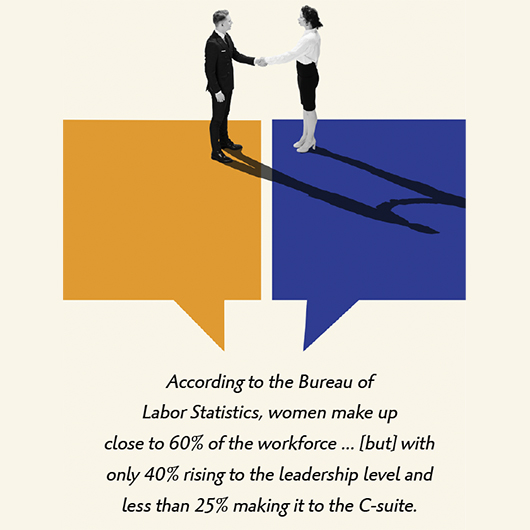
Did you know the insurance industry is female dominated? That’s right. According to the Bureau of Labor Statistics (BLS), women make up close to 60% of the workforce, but gender disparity in the workforce isn’t the problem. Instead, it’s the leadership gap that widens as women progress in their careers, with only 40% rising to the leadership level and less than 25% making it to the C-suite.
Why does this matter?
Let’s start with the Great Wealth Transfer. Have you heard of it? A recent report from Cerulli Associates estimates that $124 trillion will be transferred through 2048 and 70% is expected to go to women (surviving spouses and younger generations). Women will soon control more money than ever before.
Let’s talk about the correlation between diverse executive teams and performance. McKinsey & Company found that businesses with gender-diverse leadership are 27% more profitable and generate 19% more revenue from innovation.
Further, the Independent Insurance Agents & Brokers of America surveyed 500 women and found that 80% are responsible for the financial planning and decision-making in their households, including purchasing personal lines of insurance. Additionally, 72% of women would be more inclined to purchase insurance if the policy offerings were presented by a woman.
Access to wealth, improved performance, and an increased close rate? I could keep going, but I’m guessing I have your attention now. Psychologist Nathaniel Branden once said, “The first step toward change is awareness.” He had a second step, but I’d like to propose a few of my own.
First, reflect on your career and ask yourself the following questions:
- What were the key inflection points in your career that propelled you forward?
- Who noticed or believed in your potential early on, and how did they show it?
- Were there moments when someone took a chance on you even if you weren’t 100% ready?
Second, look inside your organization and consider these questions:
- Are the women in your organization today, especially those with the drive and talent you had, being given the same access to stretch roles, visibility, and support that helped you advance?
- What unspoken systems or default assumptions might still be holding women back, even unintentionally?
- When you consider how leadership potential is recognized today, is it being measured equitably for both men and women? How do you know?
What do these reflections reveal about how opportunity shows up or doesn’t in your organization? What’s one small shift you could make to widen the path for someone else, especially someone who’s not being seen? How do you ensure the leaders in your organization are aware of potential leadership gaps?
What’s your next move?
Shirley Chisholm, the first African American woman to be elected to Congress, once said, “You don’t make progress by standing on the sidelines. You make progress by implementing ideas.”
Here are a few ideas from my research and experience working with companies from the Fortune 500 to family-owned and everywhere in between.
Build experience capital. There are many rungs on the ladder from entry-level employee to the C-suite. The authors of The Broken Rung: When the Career Ladder Breaks for Women – and How They Can Succeed in Spite of It share that “when the first promotions to become manager happen, the odds of advancement are lower for women.” They go on to say, “Every rung on the corporate ladder is broken. It is that first broken rung, however, that affects everything else beyond the entry level.”
So, how do we repair that first broken rung? The authors introduce the concept of “experience capital,” or the value of the skills and experiences gained on the job, especially early in your career.
What are the skills you’ll look for in your next chief human resources officer (CHRO), CFO, or CEO? Start building these skills early. If a CHRO needs to understand the performance management process, explain it to your individual contributors and new supervisors. If a CFO needs to manage a profit and loss (P&L) statement, start teaching your account managers about revenue and expense drivers now. And, if your next CEO will be tasked with growing through acquisition, expose your middle managers to the due diligence process.
To build experience capital your next move could be:
- Conducting a skills gap conversation with your direct reports and activate a plan to close the gaps
Assigning a stretch assignment to a high-potential female on your team and publicly celebrate the successful completion
- Teaching a class on insurance financials to your team and connecting their goals to the company’s P&L
Overcome biases. We all have biases (both conscious and unconscious), and if left unchecked, they can lead to discrimination. Let’s look at just one: affinity bias. When we gravitate toward people who are similar to us and avoid those who are different that’s an affinity bias. Think about just one way this shows up in the workplace. A manager promotes an employee because they share the same hobby.
Golf anyone?
While trying to fully eliminate biases is an exercise in futility, we can increase our awareness and implement processes and procedures to overcome them. For example, what are the criteria for promotion at your firm? Are they accessible to everyone in the firm? What is the process for promotion and how do you measure its success to ensure fairness?
To overcome biases, your next move could be:
- Amplifying the voices of women in meetings by repeating what they say or asking them to say more
- Reviewing and measuring your company’s pay equity
- Actively sponsoring a woman on your team by elevating her name, her work, and her potential in the spaces where decisions are made
Coach the coaches. If you’re a senior leader reading this, you may be thinking, yes, I know and understand the importance of these skills and experiences. But let’s look at a level or two below where you sit. Are your middle managers equipped to develop their entry-level employees in this way?
Author Brené Brown writes, “Leaders are the only people in the world where high performance is expected, and a coach is not normative.” Think about it: Athletes, actors, and artists all have coaches. Do your leaders?
To coach the coaches, your next move could be:
- Involving them in the goal-setting process for their teams. Ensure goals are equitable and outcome focused.
- Training them on the performance management process. Model consistent coaching for them and observe them in action.
- Hiring a coach for them. The next generation of leaders is hungry for feedback. If you don’t prioritize it, you risk losing them and depleting your leadership pipeline.
The leadership gap is not unique to insurance. Depending on which report you read, U.S. businesses will reach gender parity in senior leadership somewhere between five years from now and 100. I like to think I’m equal parts practical and optimistic, so let’s call it 50. That means my little girl, who wanted to be an insurance agent like her mom a few years ago, might not see the leadership gap close in her working life.
I don’t know about you, but I can’t wait that long. I won’t wait that long.
What’s your next move to close the leadership gap?
The author
From call center floors to executive leadership, Julie Webb has built a dynamic career in the insurance industry, spanning frontline operations, regional territory oversight, and entrepreneurship. In 2020, she launched and led an independent agency. Prior to that she served as a regional vice president overseeing the Mid-Atlantic footprint for a national agency network. She began her career in GEICO’s Leadership Development Program where she ultimately built and led a regional sales and service call center.
Always a passionate advocate for connection and advancement in the workplace, Julie now channels that work into JMW Collective, her leadership consulting practice. Through coaching, workshops, and mastermind facilitation she equips leaders to build cultures where people are supported and set up to thrive.